Relationship Intelligence for BFSI Sales: The Missing Layer Between Warm Paths and Revenue Action
Generic relationship intelligence tools can show who knows whom. BFSI sales teams need more: warm-path discovery, hierarchy-aware client mapping, signal-driven coverage, and RM-approved next actions.
Relationship intelligence for financial services sales teams is not just a map of who knows whom. In BFSI, it needs to show which banker, advisor, portfolio specialist, product leader, alumni contact, or deal-team member has the strongest path into a client, household, institution, committee, or issuer — and why that path matters now.
Horizontal relationship intelligence platforms helped define the category for VC, PE, and professional services. BFSI relationship-led sales needs a deeper layer: warm-path discovery across firm networks, hierarchy-aware relationship modeling, signal-driven coverage, and AI-prepared next actions that relationship managers can review, approve, and send.
Table of Contents
- Why Relationship Intelligence Is the Missing Layer in BFSI Sales
- What Relationship Intelligence Is — and What It Is Not
- The Vendor Landscape — and the BFSI Gap
- The Four Capabilities a BFSI Relationship Intelligence Layer Needs
- Four BFSI Scenarios
- How Relationship Intelligence Connects to Revenue Execution
- Evaluation Checklist
- FAQ
Introduction
Relationship-led sales is the operating model across much of financial services. Private bankers manage family relationships over decades. Commercial bankers grow with companies through multiple credit, treasury, and liquidity needs. Asset managers build distribution through advisors, consultants, platforms, and investment committees. Capital markets teams maintain issuer relationships across transaction cycles, product desks, and leadership changes.
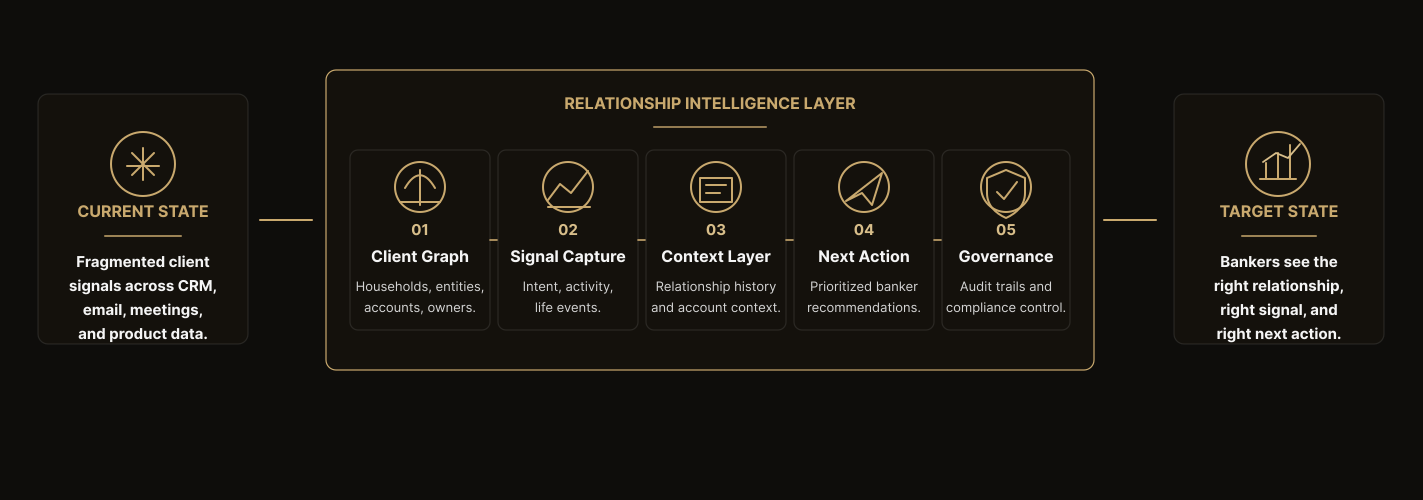
The problem is not that these firms lack relationship knowledge. The problem is that the knowledge is scattered across inboxes, calendars, CRM records, deal histories, advisory work, product systems, and the memories of experienced relationship managers.
That is why relationship intelligence for financial services sales teams needs to go beyond generic contact mapping. A BFSI-ready relationship intelligence layer should answer four operational questions:
- Who inside the firm has the strongest path into this person, household, institution, advisor, consultant, or issuer?
- How does that person connect to the broader client hierarchy?
- What revenue, transaction, market, or engagement signal makes this relationship worth acting on now?
- What should the relationship manager do next, and what context do they need before reaching out?
This article explains how relationship intelligence works in BFSI, where horizontal platforms fall short, which capabilities matter most, and how the layer connects to revenue execution for financial services.
Why Relationship Intelligence Is the Missing Layer in BFSI Sales
BFSI sales motions are built on trust, continuity, and institutional memory. A private banking relationship may begin with one founder and expand into a spouse, adult children, trusts, a family office, a foundation, and a business entity. An asset management relationship may start with one advisor and later run through an RIA platform, investment committee, home-office research team, and consultant channel. A capital markets relationship may span ECM, DCM, structured products, treasury, and corporate leadership over many years.
Most sales systems do not model that reality well. CRM accounts are often flat. Opportunities are often transactional. Communication history lives in email and calendar tools. Relationship context sits with individual bankers, advisors, wholesalers, and coverage teams.
Relationship intelligence closes that gap by making relational capital visible and usable. It helps teams see who knows whom, which paths are warm, where coverage is single-threaded, and which relationship-aware action should happen next. That is why it belongs alongside entity resolution for financial services and revenue signal intelligence inside a wider SellWizr platform view of coverage.
What Relationship Intelligence Is — and What It Is Not
The category is often confused with adjacent things. Precision matters.
Relationship intelligence is the automated mapping and reasoning layer that helps financial services sales teams understand relationship strength, warm-path access, and coverage context across people, accounts, households, institutions, and decision networks.
Relationship intelligence is:
- A way to infer relationship strength from communication, meetings, deal history, advisory work, board connections, alumni ties, and engagement patterns.
- A relationship map that shows warm paths between internal teams and external decision-makers.
- A coverage layer that helps identify single-threaded relationships, neglected stakeholders, and high-value paths into an account.
- In BFSI, a hierarchy-aware layer that connects people to households, legal entities, funds, subsidiaries, trusts, advisors, consultants, committees, and issuers.
Relationship intelligence is not:
- A directory. A directory lists people. Relationship intelligence explains relationship strength and usable paths.
- A CRM replacement. CRM stores records. Relationship intelligence reasons across CRM, communication data, relationship history, and engagement patterns.
- A replacement for the RM. The relationship manager still owns judgment, trust, and outreach. The system prepares the map, context, and recommended action.
The Vendor Landscape — and the BFSI Gap
The relationship intelligence category is well established, but much of it was built around deal sourcing, professional networks, and project-based origination. Those are valuable motions, especially in venture capital, private equity, family offices, and professional services.
BFSI relationship sales has a different operating model. Coverage is ongoing. Client structures are complex. Signals come from transactions, balances, product usage, market events, fund flows, and relationship activity. The right question is not only "Who can introduce us?" It is also "Which relationship needs attention, what changed, who has the best path, and what should the RM do next?"
That is where horizontal tools can struggle. A BFSI relationship intelligence platform needs to model multi-entity relationships, incorporate financial-services-specific signals, and connect insight to action inside the workflows relationship teams already use.
Three category clusters anchor the market. Each is well-built for the segment it targets.
Private capital relationship intelligence. AI-powered platforms aimed at venture capital, private equity, family offices, and wealth managers. Strong for sourcing and origination motions. The underlying relationship graph is the strength; these platforms were not primarily built around multi-entity legal hierarchies, financial-services-specific transaction signals, and agentic execution integrated with a BFSI CRM as the system of record.
Deal-team relationship intelligence. Automation focused on pulling contact and communication data from inboxes and calendars to keep CRM records updated for deal teams. Strong for deal teams and professional services firms with project-based engagement. The relationship model is project-led; household-led and institution-led coverage often is not supported at the depth BFSI requires.
Executive-network relationship discovery. Strong for breaking-the-ice motions and deal sourcing where the target is a specific decision-maker rather than an institutional client.
The wider category. A long tail of adjacent variants — sales-team-focused, institutional-investor-focused, and increasingly LLM-native entrants. Most of these are oriented toward dealmaking workflows rather than ongoing relationship motions.
The BFSI gap is consistent. Horizontal relationship intelligence tools can struggle when relationship coverage depends on: (a) multi-entity hierarchies (holding company, subsidiaries, funds, family trusts, households); (b) BFSI-specific signals (transactions, fund flows, market events); and (c) agentic execution integrated with the system of record the RM actually uses for ongoing coverage. Several of these platforms recognise the gap and are extending into adjacent capabilities; the structural fit for BFSI ongoing relationship motions remains incomplete.
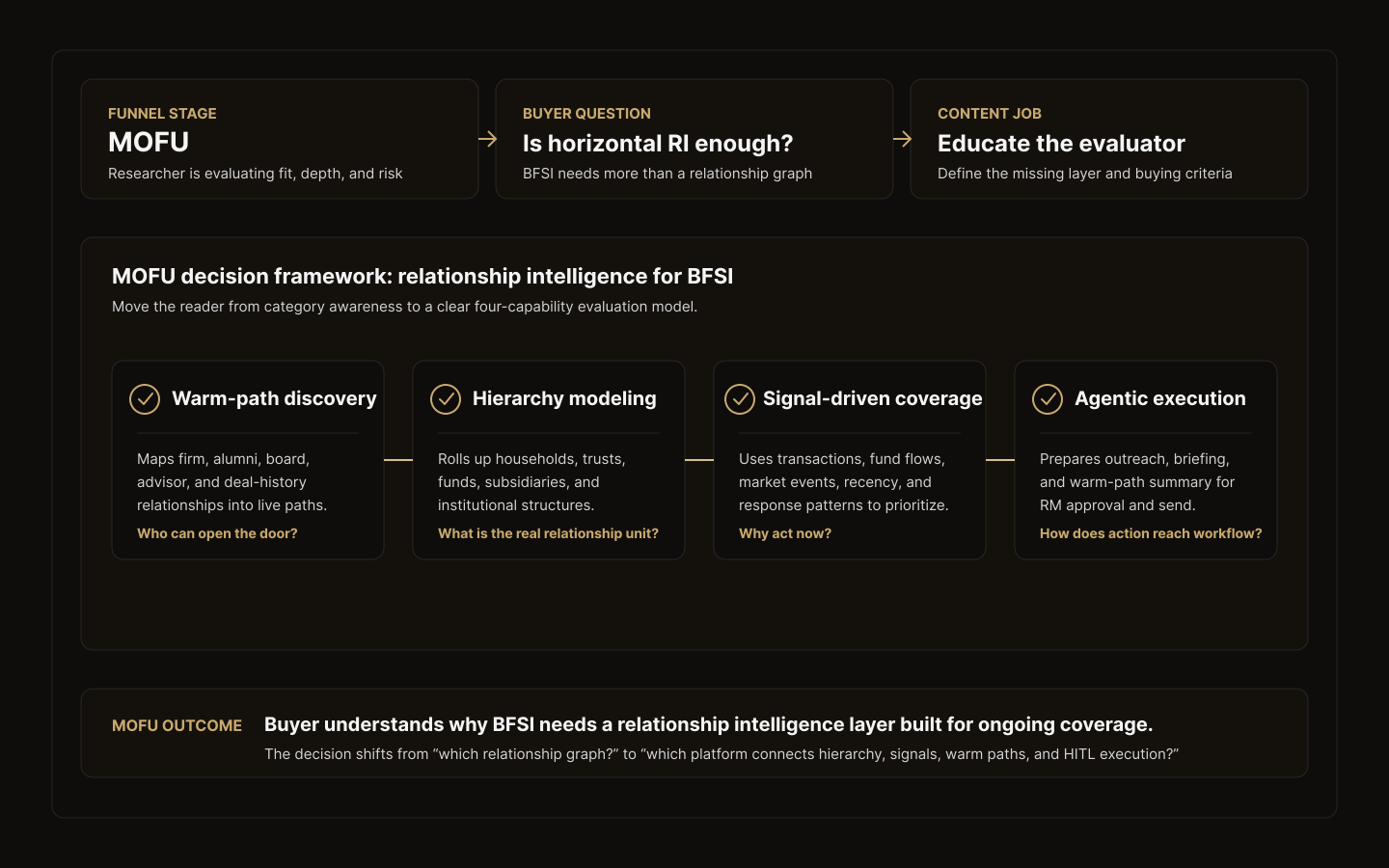
The Four Capabilities a BFSI Relationship Intelligence Layer Needs
1. Warm-path discovery across the full firm network
Not just current employees. BFSI firms often have valuable relationship paths through alumni, board members, advisors, prior covering bankers, deal teams, syndicate participants, product specialists, and senior leaders. The system should surface those paths without forcing the RM to manually ask around.
2. Hierarchy-aware relationship modeling
Coverage should roll up to the real relationship unit, not just the CRM account. In wealth, that may mean a household, trust, family business, foundation, and next generation. In commercial banking, it may mean parent companies, subsidiaries, treasury users, credit relationships, and owners. In asset management, it may mean the advisor, RIA, home office, platform, consultant, and investment committee.
3. Signal-driven coverage prioritization
Relationship intelligence becomes more valuable when it is connected to timing. A warm path matters more when there is a deposit shift, fund flow movement, product usage change, portfolio event, capital raise, mandate review, or engagement signal. The best systems help the team understand not only who to contact, but why now.
4. AI-prepared execution with human approval
For BFSI teams, the output should not be another dashboard. The useful output is a prepared action: a relationship map, account brief, suggested outreach angle, supporting signal, and draft message routed to the RM or advisor for review. Human judgment remains central; the prep work becomes faster and more consistent.
A platform that ships only the first capability is a network discovery tool. A platform that ships all four is the relationship intelligence layer BFSI sales has needed for a decade and has not yet had.
Four BFSI Scenarios
The value of relationship intelligence is easiest to see in the moments where relationship context changes the next action. These are not cold outbound examples. They are coverage, continuity, and timing examples.
Scenario 1 — Private banking succession event. A founder who exited a logistics business is the firm's anchor private-banking relationship, but the relationship sits almost entirely with one senior banker who is eighteen months from retirement. The risk is not data fragmentation — it is single-threaded coverage. A relationship intelligence layer maps the firm's full relational surface to the founder and his circle: the M&A banker who advised on the 2023 exit and still trades messages with the founder's CFO; the junior advisor who covered the founder's brother-in-law at a prior firm; the philanthropy team already engaged with the family foundation the founder seeded post-exit. Instead of one fragile thread, the layer exposes three live paths and scores their strength and recency. The AI-prep layer drafts a structured introduction plan — who reaches in, on what pretext, in what order — and a coverage-continuity briefing for the retiring banker to hand off. The bank converts a key-person risk into a multi-threaded relationship before the retirement, not after it. See the deeper treatments in wealth management revenue execution and the client 360 platform for banks.
Scenario 2 — Asset management distribution via shared board history. A large RIA platform appears as a target on the firm's coverage list. The platform's CIO sat on a charity board five years ago with the firm's head of fixed income. The CRM does not know this; the relationship intelligence layer does. The wholesaler covering the platform sees the warm path surfaced, requests an introduction from the head of fixed income, and the first conversation happens at relationship temperature rather than cold outbound. This is the pattern that separates distribution-heavy firms with strong coverage rhythm from those still working single-thread. Explore the wider distribution motion in asset management distribution intelligence.
Scenario 3 — Capital markets issuer relationship across deal teams. A repeat issuer has done four transactions with the firm over eight years across three different desks: ECM, DCM, and structured products. The deal team relationships are recorded in three different systems. A new mandate is coming. A relationship intelligence layer pulls together the full historical relationship map — who covered the issuer in which transaction, which deal team members remain at the firm, who the issuer's current CFO worked with as a junior banker on the 2018 transaction. The new pitch reflects the full relationship history rather than the most recent deal. This is institutional relationship continuity, and it is one of the layers the SellWizr platform is designed to preserve across desks.
Scenario 4 — Institutional consultant relations and a contested mandate. An asset manager is competing for a large public-pension mandate, but the decision runs through an investment consultant and a seven-person investment committee — and the firm's relationship is single-threaded through one institutional salesperson who knows only the consultant's field rep. A relationship intelligence layer maps the firm's full relational surface to the opportunity: the portfolio manager who presented at the consultant's research conference last year; a former colleague now sitting on the pension's investment staff; the client-service lead who already covers another plan advised by the same consultant office. It scores each path for strength and recency, and — most usefully — flags that the committee chair and two newer trustees have no warm path at all, the exact coverage gap that loses competitive mandates. The AI-prep layer builds a multi-threaded engagement plan: who reaches into the consultant, who reaches the staff ally, and how to arrange a credible introduction to the unconnected trustees before the finals presentation. The firm walks into the finals known to the room rather than pitching cold to a committee that has never met them. This is one of the layered coverage patterns discussed in revenue execution for financial services.
In each scenario the operational test is the same: did the relationship insight reach the seller, inside their existing workflow, in time to change the action they would have taken without it?
How Relationship Intelligence Connects to Revenue Execution
Relationship intelligence is one part of a complete next-best-action system for financial services. It explains the relationship path. Entity resolution explains the client structure. Signal detection explains why the action matters now.
Together, those layers answer the questions an RM actually needs answered:
- Who is the client or relationship unit?
- What changed?
- Who has the strongest path?
- What should we do next?
- What context should be included before outreach?
This is where relationship intelligence connects to revenue execution for financial services. The relationship layer should not live as a separate dashboard that sellers occasionally check. It should feed the action layer: account briefings, warm-path summaries, next-best-action recommendations, and RM-approved outreach.
Without entity resolution for financial services, relationship intelligence can attach insight to the wrong account. Without revenue signal intelligence, it becomes a static network map. Without an execution layer that reaches the RM inside their existing workflow, it may never change what the RM does. And without a broader client 360 visibility view of the household or institution, the recommended action may miss context that sits one entity away.
The structural argument: relationship intelligence is one core capability of a revenue execution layer for financial services, not a standalone tool. BFSI institutions that buy it as a standalone product typically integrate it poorly with their CRM and stall the adoption. The related architectural view is in AI sales intelligence for banks.
Evaluation Checklist
A serious BFSI evaluation of a relationship intelligence platform covers eight questions.
- Warm-path breadth. Does the platform pull from current employees, alumni networks, board memberships, prior advisory work, and deal history — or only current employee communications?
- Hierarchy modeling. Are households, family entities, holding companies, subsidiaries, funds, trusts, advisors, consultants, and committees modelled as first-class relationship units, not flat accounts?
- Signal incorporation. Does the platform incorporate financial-services-specific signals (transactions, fund flows, deposit patterns, product usage, market events) into relationship scoring — or only communication signals?
- Workflow integration. Does the platform surface warm paths, briefings, and recommended actions inside the CRM and workflows the RM or advisor already uses — or does it live in a separate dashboard?
- AI-prepared action. Does the platform prepare a relationship-aware next action — warm-path map, account brief, source signal, draft outreach — for the RM to review and approve, or does it stop at a recommendation?
- Explainability. For every warm path and relationship score, can the platform show the underlying data (communications, calendar history, deal history, board records) so the RM can trust the inference?
- Deployment posture. What deployment models does the platform support, what does its audit logging look like, and how does it handle data residency requirements common in BFSI procurement?
- Coverage telemetry. Does the platform measure adoption (acted-on warm paths), conversion (warm-path-led opportunities), and coverage hygiene (households or institutions covered vs uncovered) so the value is provable over time?
Use this checklist alongside the broader AI sales intelligence for banks evaluation framework when comparing vendors end-to-end.
Conclusion
Relationship intelligence is the missing layer in BFSI sales because financial services growth is rarely driven by one isolated contact or one isolated opportunity. It is driven by relationship depth, institutional memory, timing, and the ability to coordinate coverage across complex client structures.
Horizontal relationship intelligence tools helped prove the value of relationship graphs. BFSI teams need the next version: relationship intelligence that understands households, institutions, committees, issuers, advisors, alumni paths, deal history, product signals, and RM workflows.
The strongest use case is not simply finding an introduction. It is helping financial services teams know which relationship deserves attention, which internal path is strongest, what changed, and what action should be prepared for human review.
That is why relationship intelligence belongs inside revenue execution for financial services. On its own, it is a map. Connected to entity resolution, signal detection, and AI next-best-action workflows, it becomes a system for turning relationship knowledge into timely, relationship-aware action.
Summary. Relationship intelligence for financial services sales teams is more than a graph of who knows whom. In BFSI it needs to model warm paths across the full firm network, roll relationships up to hierarchies (households, institutions, committees, issuers, advisor networks), incorporate financial-services signals, and prepare relationship-aware next actions for RM review. Horizontal relationship intelligence tools helped define the category; BFSI teams need the next version, embedded inside revenue execution for financial services alongside entity resolution, signal detection, and AI next-best-action workflows. Evaluation hinges on warm-path breadth, hierarchy modeling, signal incorporation, workflow integration, explainability, and whether the output becomes an RM-ready action rather than another dashboard.
FAQ
What is relationship intelligence for financial services sales teams?
Relationship intelligence for financial services sales teams is the use of data and AI to map relationship strength, warm paths, stakeholder networks, and coverage gaps across clients, households, institutions, advisors, committees, and issuers.
How is relationship intelligence different from CRM?
CRM stores account, contact, and opportunity records. Relationship intelligence reasons across CRM, communication history, deal history, advisory work, and engagement patterns to identify who knows whom, how strong the relationship is, and what path should be used.
Why do BFSI teams need relationship intelligence?
BFSI sales depends on long-term trust, complex client structures, and multi-threaded coverage. Relationship intelligence helps teams avoid single-threaded relationships, missed warm paths, and relationship context trapped in individual inboxes.
What makes BFSI relationship intelligence different from generic relationship intelligence?
BFSI relationship intelligence needs hierarchy-aware modeling, financial-services-specific signals, warm-path discovery across firm networks, and integration into RM or advisor workflows.
How does relationship intelligence support AI next-best action in financial services?
It provides the relationship context behind the action: who has the best path, why that path matters, and what context should be included before outreach.
Is relationship intelligence the same as account intelligence?
No. Account intelligence explains what is happening with an account. Relationship intelligence explains who is connected to whom, how strong those relationships are, and how the team can use those paths responsibly.
How does relationship intelligence help private banking and wealth management?
It helps teams map households, family entities, next-generation relationships, centers of influence, and internal coverage paths so that important relationships are not dependent on one advisor or banker.
What should BFSI buyers evaluate in a relationship intelligence platform?
They should evaluate warm-path breadth, hierarchy modeling, signal incorporation, workflow integration, explainability, deployment posture, and whether the output becomes an RM-ready action rather than another dashboard.
Want to see how relationship intelligence becomes action?
See how SellWizr helps financial services teams connect warm paths, client hierarchies, and revenue signals into RM-ready next actions.