The Hidden Cost of Dirty CRM Data in Financial Services
Dirty CRM data is more than a cleanup issue in BFSI. It creates revenue leakage, unreliable forecasts, stalled AI programs, and CRM distrust when client entities and hierarchies are not resolved across systems.
Dirty CRM data in financial services is not just a field-cleanup problem. When the same client, household, fund, subsidiary, or commercial entity appears differently across CRM, core banking, transaction, product, and KYC systems, the result is revenue leakage, unreliable forecasts, stalled AI programs, and declining trust in CRM. Periodic dedupe can clean obvious duplicates. The durable fix is continuous entity resolution, hierarchy-aware unification, and AI-ready revenue data that can be written back into the workflows relationship teams already use.
Table of Contents
- What Dirty CRM Data Actually Means in Financial Services
- The Seven Hidden Costs of Dirty CRM Data in BFSI
- What Bad CRM Data Costs in Hard Dollars
- Why Financial Services Pays a Higher Dirty-Data Tax
- Why Periodic Dedupe Software Is Not Enough
- From CRM Cleanup to AI-Ready Revenue Data: A 90-Day Path
- What Improves When CRM Data Becomes Trustworthy
- FAQ
Introduction
Dirty CRM data in financial services is a structural condition, not a maintenance task. A commercial client, wealth household, institutional allocator, fund, trust, or subsidiary can appear across CRM, core banking, transaction warehouses, product platforms, KYC repositories, marketing systems, and advisor notes without being resolved into the same relationship. The result is duplicate records, stale hierarchy relationships, misattributed pipeline, missed cross-sell opportunities, and AI models trained on inputs the data team already knows are unreliable.
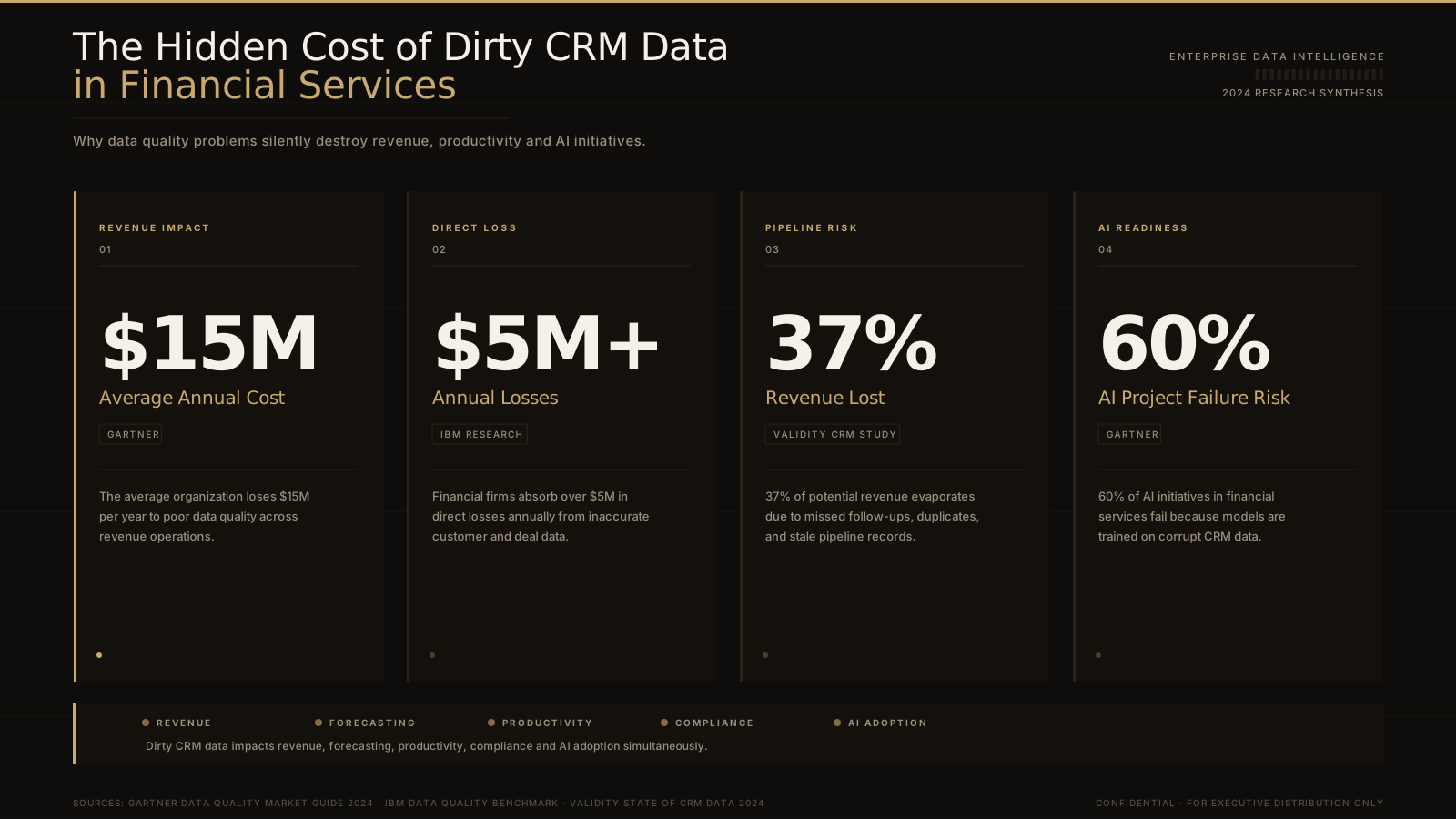
The aggregate cost is well documented. Gartner estimates dirty data costs the average enterprise $15 million per year. IBM's research has found that many organizations lose millions annually to data quality failures alone. Validity's State of CRM Data Management research reports that many CRM users believe less than half their data is accurate and complete, and a meaningful share have lost revenue as a direct consequence. In BFSI, the cost ratio can be higher because financial-services institutions manage more systems per client, more complex entity relationships, and more downside when identity or hierarchy data is wrong.
The standard response — periodic deduplication software, a CRM cleanup project, or a CRM migration — does not address the structural cause. Dedupe handles field-level dirt. A CRM migration often recreates the same fragmentation under a new interface. The durable fix is entity resolution for financial services: a continuous layer that resolves records, manages hierarchies, creates trusted golden records, and pushes cleaner context back into the systems relationship teams already use.
This article breaks down the hidden costs of dirty CRM data in financial services, gives revenue and data leaders a practical cost formula, and explains the path from periodic CRM data hygiene to AI-ready revenue data.
What Dirty CRM Data Actually Means in Financial Services
In most SaaS environments, dirty data means missing fields, stale contact details, and duplicate leads. In BFSI, the problem is structurally larger and sits in five distinct layers.
Field-level dirt. Stale emails, missing phone numbers, mistyped firm names, and inconsistent industry codes. This is the layer most dedupe tools address, and it is the smallest slice of the problem.
Entity-level dirt. The same legal entity appears as multiple accounts under different names ("Acme Holdings Inc.", "Acme Holdings", "ACME Holdings, Inc."). Basic dedupe can catch some string variants but rarely resolves legal-name aliases or cross-system identifiers.
Hierarchy-level dirt. A holding company's subsidiaries, funds, SPVs, and trusts sit as separate accounts with no parent-child linkage. The dedupe tool has no way to know these belong together — it requires registry data, entity-resolution logic, and human review. The institutional-sales version is just as costly: a pension plan, its investment committee, its OCIO, and its gatekeeping consultant sit as unlinked records, so the asset manager cannot see that an open manager search and an existing mandate belong to the same allocator relationship.
Signal-level dirt. Last-touched dates and pipeline stages are out of sync with reality. The RM had a treasury conversation last week; the system shows no interaction in 60 days because the call went to a personal Outlook calendar, not the CRM.
Lineage-level dirt. Even when the data is correct, the institution cannot prove where it came from. A defensible lineage trail does not exist. The record is right but undefendable.
All five layers compound. That is why fixing dirty CRM data in financial services requires more than CRM data cleansing. It requires knowing which records describe the same real-world relationship, which entities belong together, which source is authoritative, and which updates are safe to activate in the CRM.
The Seven Hidden Costs of Dirty CRM Data in BFSI
Cost decomposition is what turns a vague "data quality" complaint into a board-ready business case.
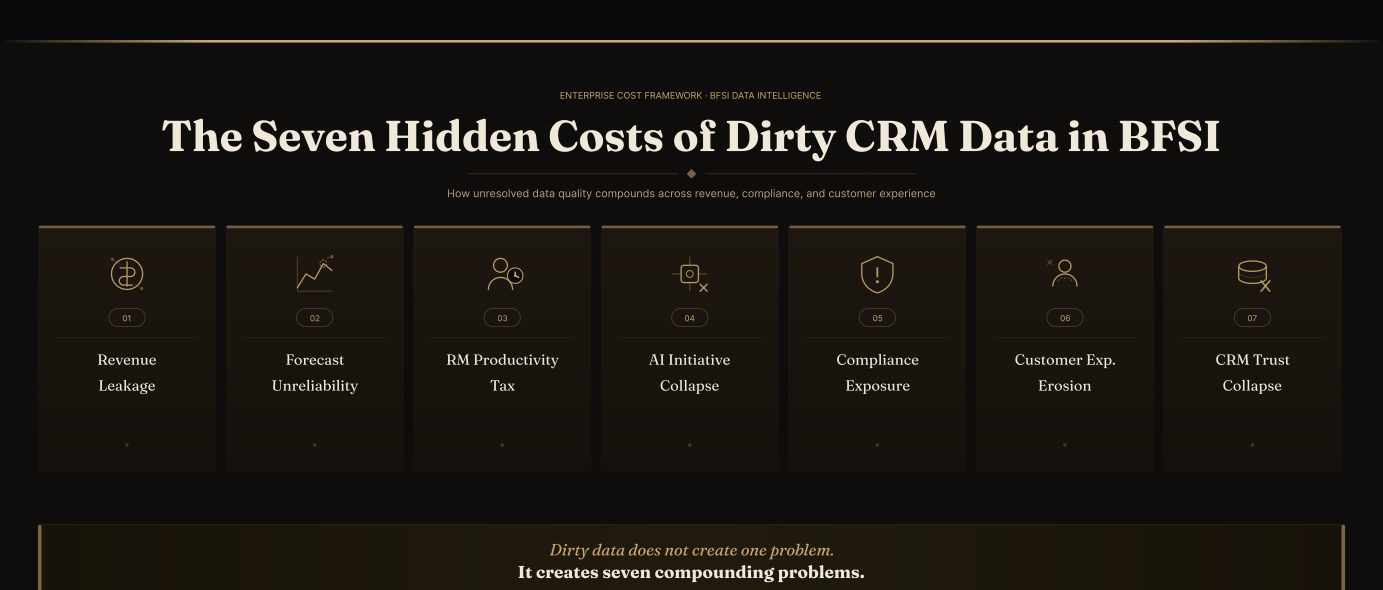
Cost 1 — Revenue leakage. Bad data revenue loss shows up in missed cross-sell because a parent is not linked to its subsidiary, in double coverage where two RMs chase the same resolved client, and in lost renewals when the relationship signal lives in a record nobody is watching. Validity reports 37% of CRM users have directly lost revenue to data quality.
Cost 2 — Forecast unreliability. Pipeline math built on duplicate records produces a forecast no executive trusts, and forecast reliability collapses in the same quarter the CRO needs it most. The CRO discounts the number; the board discounts the CRO; the cycle compounds. The cost shows up in lost credibility, not lost revenue — but credibility is what determines next quarter's investment.
Cost 3 — RM productivity tax. Industry research shows reps spend ~60% of time on non-selling tasks (Salesforce, State of Sales). Validity's 2025 research shows up to 32% of total time goes to data issues inside the CRM. For a 150-RM bank at $300K loaded cost, that is roughly $13.5M per year in pure productivity waste — before any revenue impact.
Cost 4 — AI initiative collapse. Gartner predicts 60% of AI projects will be abandoned by organisations lacking AI-ready data. Accenture's Q1 2026 banking survey found 91% of executives call AI strategic, while only 23% have moved it into production. The data is the bottleneck, not the model.
Cost 5 — Compliance exposure. KYC and AML processes that depend on resolved identity break when entities are duplicated. A subsidiary missed in screening, a trust unlinked from its beneficial owner, or a counterparty appearing under a variant name creates remediation work, potential findings, and capital reserved against operational risk.
Cost 6 — Customer experience erosion. The same family receives three contradictory outreach attempts from three lines of business in two weeks. The household perception of the institution is "they don't talk to each other." For a wealth firm, this is the silent killer of the relationship.
Cost 7 — CRM trust collapse. Once relationship managers believe the CRM is wrong, they stop treating it as the operating system for the relationship. They revert to spreadsheets, side notes, personal inboxes, and informal coverage lists. The CRM becomes a reporting shell for QBRs instead of a system of action. That trust collapse is expensive because the institution loses visibility into the activity that actually drives pipeline, renewal risk, and relationship growth.
These costs compound. A bank with three of them is recoverable. A bank with six is in a transformation programme whether the board has named it yet or not.
What Bad CRM Data Costs in Hard Dollars
A defensible business case requires the reader's own number. The formula:
Annual dirty-data tax = Revenue leakage from bad CRM data
- RM/advisor productivity waste
- AI program rework or abandonment risk
- compliance/remediation effort
- customer experience and retention impact
As an illustration, take a $5B revenue bank with 150 RMs at a $300K loaded cost. Run the most conservative case:
- Revenue leakage (0.5–1% of $5B, conservative anchor): $25–50M
- RM productivity waste (150 × $300K × 30%): $13.5M
- AI program risk (assume a $20M annual AI budget × 60% abandonment risk): $12M
- Subtotal before compliance and customer-experience impact: ~$50–75M annual dirty-data tax
The assumptions here are illustrative and conservative, not guaranteed. A CFO pressure-testing 0.5–1% revenue leakage will accept it readily, and the resulting subtotal is still board-relevant. The point of the formula is not the absolute number; it is to translate the Gartner $15M average into the reader's own scale and to make the "do nothing" decision quantifiable.

Why Financial Services Pays a Higher Dirty-Data Tax
Cross-industry, 89% of organisations struggle with data quality (Experian). In financial services — across banks, lenders, wealth firms, asset managers, payments teams, and institutional sales desks — the practical cost ratio is meaningfully higher. Four structural reasons.
One, multi-entity hierarchies. Holding companies, subsidiaries, funds, trusts, households, and advisor relationships. Every level of hierarchy left unresolved is a cost multiplier. Moody's has documented this directly: complex companies with multiple legal hierarchy levels are where master data breaks first.
Two, more systems per client. Core banking, CRM, transaction warehouse, product platforms, digital channels, KYC, and marketing automation. The average BFSI client appears in five to seven systems. Cross-industry SaaS clients typically appear in two to three.
Three, higher downside when records are wrong. A dirty record in a SaaS CRM is a lost lead. A dirty record in a BFSI CRM can create a KYC issue, a duplicated regulatory report, or an incorrect allocation. The downside is asymmetric.
Four, RM and advisor economics. A BFSI relationship manager or advisor at $300K+ loaded cost, producing multi-million dollar revenue per book, makes every hour of productivity waste expensive in absolute dollars. A SaaS BDR at $90K loaded cost makes the same productivity-waste line item smaller per head — meaningful at scale but not the same dollar magnitude.
The implication: financial-services institutions should not benchmark themselves against the $15M cross-industry average. They should benchmark against the formula above, with their actual revenue and headcount inputs. For larger financial-services institutions, the internal cost can materially exceed cross-industry averages because the same data issue affects revenue, coverage, service, risk, and AI-readiness at the same time. See the deeper structural treatment in why BFSI sales teams are drowning in fragmented CRM data.
Why Periodic Dedupe Software Is Not Enough
The default response to dirty CRM data is to buy a dedupe tool. There is a market of them; they are useful at the field level. They are insufficient at the BFSI level. Three reasons.
Periodic, not continuous. Dedupe runs weekly or monthly. The CRM is being modified daily, and upstream systems are modifying records in real time. A periodic cleanup is always behind reality.
Single-system, not cross-system. Dedupe tools clean what is inside the CRM. The dirt originates upstream: core banking, product systems, the warehouse. Cleaning the CRM without resolving upstream means the bad data returns at the next sync.
Field-aware, not entity-aware. Dedupe matches on name, email, phone, and domain. It does not natively model legal hierarchies or maintain golden records across multi-entity clients. Hierarchy-aware entity resolution is a different category of capability.
For institutions serious about fixing dirty CRM data in financial services, dedupe is only one layer of the answer. The larger requirement is continuous entity resolution, hierarchy management, source confidence, and workflow write-back. That is closer to automated data cleaning and enrichment than to a scheduled dedupe pass.
The durable fix is a continuous entity-resolution layer above the CRM — one that ingests from authoritative sources, maintains golden records and hierarchies, instruments data observability with lineage, and writes resolved records back into the CRM with audit trails. CRM data hygiene becomes a continuous operating discipline rather than a quarterly project. This is one of the operational expressions of revenue execution for financial services, and it depends on unifying internal and external data into a shared view.
From CRM Cleanup to AI-Ready Revenue Data: A 90-Day Path
A pragmatic 90-day sequence to move from dirty CRM data toward AI-ready revenue data — without a full CRM migration.
Days 1–15 — Diagnose the dirty-data tax. For a representative 100-client sample, count duplicates, unresolved hierarchies, stale records, and upstream system inconsistencies. Apply the cost formula above. Identify the two highest-cost patterns and the lines of business they hit hardest.
Days 16–45 — Define the entity-resolution scope. Choose the first LOB and product line. Define the upstream sources to ingest (CRM, core banking, transaction warehouse, KYC, registry data). Define the entity-resolution scope: which hierarchy types matter, what matching logic is acceptable, and what confidence thresholds are required before a record is treated as trustworthy.
Days 46–75 — Build the trusted data layer. Stand up ingestion, resolution, and golden-record management against the scoped LOB. Validate against the 100-client audit sample. Wire data observability and lineage. Build the audit log so every resolved record is defensible.
Days 76–90 — Activate cleaner data in frontline workflows. Begin writing resolved records back into the CRM and surfacing AI next-best actions inside the tools RMs and advisors already use. Instrument adoption and outcome telemetry. Define the next two LOB expansions.
This sequence outperforms a 24-month CRM migration. The institution keeps the CRM as the system of record; the unification layer is additive; the first data-quality improvement lands inside 90 days. The evaluation criteria for the underlying tooling sit in AI sales intelligence for banks, and the broader buyer's framework is in client 360 platform for banks.
What Improves When CRM Data Becomes Trustworthy
The outcomes are less about a single headline metric and more about a pattern of quiet improvements that reinforce each other.
- Fewer duplicate and conflicting records. Comprehensive validation and cleansing programs have been shown to sharply reduce error rates and processing cost when the data layer is treated as an operating discipline rather than a project.
- Better RM and advisor productivity. Time that used to go into reconciling records, chasing hierarchy answers, and rebuilding lists moves back into client conversations.
- More reliable pipeline and account planning. Forecasts and coverage reviews stop being derailed by "is this a duplicate?" arguments, and account plans reflect the real relationship instead of a fragmented view of it.
- Stronger AI readiness. Models trained on entity-resolved records produce recommendations that align with how the client relationship actually works, which is what the McKinsey research on AI-ready data across frontline banking workflows describes as the precondition for measurable revenue and cost-to-serve gains.
- Cleaner next-best-action recommendations. When the underlying record is trusted, ranked suggestions inside CRM and messaging tools stop feeling like noise and start feeling like context.
- More trust in CRM as a working system. RMs and advisors return to the CRM as the operating surface for the relationship, which reopens the pipeline visibility executives had been missing.
The pattern that separates winners from losers: winners treat dirty data as the prerequisite to AI ROI, not as a separate workstream. They sequence entity resolution first, then layer scoring and next-best action on top. The losers run AI pilots and data hygiene as parallel programmes, fail to resolve entities, watch the pilot stall, and conclude AI does not work. The data was the problem. The model was fine.
Conclusion
Dirty CRM data in financial services is expensive because it does not stay contained inside the CRM. It affects coverage, pipeline, relationship planning, AI readiness, customer experience, and executive confidence in the numbers. The same unresolved entity can create a missed cross-sell opportunity, an inaccurate forecast, a duplicated outreach motion, and a stalled AI pilot.
Periodic dedupe can help with obvious duplicates, but it does not solve the deeper issue: financial-services clients are multi-entity, multi-system, and constantly changing. Fixing the problem requires continuous entity resolution, hierarchy-aware golden records, data observability, and workflow activation so cleaner context reaches the relationship teams who need it. That is closer to a single source of truth for revenue data than to a periodic cleanup project.
For banks, lenders, wealth firms, asset managers, and other BFSI institutions, the goal is not simply a cleaner CRM. The goal is trusted, AI-ready revenue data that can support better coverage decisions, better client conversations, and better next-best actions without forcing teams into another disconnected tool.
Summary. Dirty CRM data in financial services creates a hidden tax on revenue teams, data teams, and AI programs. The problem is not limited to missing fields or duplicate contacts. In BFSI, the harder issue is unresolved entities, disconnected hierarchies, conflicting source systems, and CRM activity that no longer reflects the real client relationship. A practical fix starts with diagnosing the dirty-data tax, resolving entities across systems, creating trusted golden records, and activating cleaner account intelligence inside existing workflows.
FAQ
What is dirty CRM data in financial services?
Dirty CRM data in financial services includes duplicate records, stale fields, inconsistent client names, unresolved entities, missing hierarchy relationships, outdated activity history, and conflicting data from different systems. In BFSI, the harder layer is entity- and hierarchy-level dirt: the same client appearing across CRM, core banking, transaction, product, and KYC systems without being resolved into a single relationship.
Why is dirty CRM data more expensive in BFSI than in other industries?
BFSI data is more expensive to clean because a single relationship may include households, subsidiaries, funds, trusts, advisors, legal entities, product accounts, and multiple lines of business. The same client typically appears in five to seven systems, and the downside of getting identity or hierarchy wrong touches revenue, coverage, service, risk, and AI readiness at the same time.
How does bad CRM data cause revenue leakage?
Bad CRM data causes revenue leakage when teams miss cross-sell opportunities, duplicate outreach, misread account potential, or fail to see buying signals tied to related entities. A parent unlinked from its subsidiaries, or a household split across advisors, is often the difference between a captured opportunity and a lost one.
What is the difference between CRM data cleansing and entity resolution?
CRM data cleansing fixes field-level issues like spelling, formatting, or duplicate contacts. Entity resolution determines which records describe the same real-world client, company, household, or legal entity across multiple systems, and links related entities into a hierarchy that reflects the actual relationship.
Is dedupe software enough to fix dirty CRM data?
Dedupe software helps, but it is not enough for BFSI institutions with multi-system, multi-entity client relationships. Continuous entity resolution and hierarchy management are needed for durable improvement, along with a way to write cleaner context back into the workflows relationship teams already use.
What is a golden record in banking or financial services?
A golden record is the trusted version of a client, account, household, or entity profile that reconciles data from multiple systems and identifies the most reliable source for key fields. In BFSI, the golden record also carries the legal entity hierarchy: parent, subsidiaries, funds, trusts, and household relationships.
How does dirty CRM data affect AI initiatives?
AI models depend on reliable inputs. If CRM data is duplicated, stale, or disconnected from real client relationships, AI recommendations become less useful and harder for frontline teams to trust. Gartner has warned that many AI projects are abandoned when organizations lack AI-ready data.
Does fixing CRM data require a CRM migration?
Not always. Many institutions can improve CRM trust by adding a data resolution and activation layer above existing systems rather than replacing the CRM. This avoids multi-year migration risk and delivers data-quality improvements much sooner.
What is the first step to fixing dirty CRM data in a bank or financial-services institution?
Start with a representative sample of high-value clients or accounts. Measure duplicate records, unresolved hierarchies, stale fields, conflicting source data, and missed revenue signals before choosing technology. The output is a defensible business case a CDO and CRO can co-sponsor.
See what cleaner CRM data can unlock.
SellWizr helps financial-services teams resolve client entities, connect account context, and activate cleaner revenue intelligence inside the workflows relationship teams already use.