Why Financial Services Revenue Teams Need a Single Source of Truth
A practical guide to the architectures, governance rules, and execution layer behind trusted revenue data in financial services.
A single source of truth for revenue data in financial services is a governed, semantically consistent layer that every downstream system can trust for account, client, relationship, pipeline, product, and revenue context. It is not one database or one dashboard. It is an agreed operating model for definitions, lineage, ownership, entity resolution, and execution handoff — so CRM, BI, AI, forecasting, and relationship-manager workflows are working from the same foundation.
Table of Contents
- Why Revenue Teams End Up With Three Versions of the Truth
- What a Single Source of Truth Actually Means in Financial Services
- Why Revenue Data Silos Persist
- Three Architectures for Revenue SSOT
- The Governance Layer That Keeps Truth From Decaying
- Why Financial Services Needs an Execution Layer Above the Warehouse
- The CRO Diagnostic: Can You Rebuild the Number?
- Conclusion
- FAQ
Introduction
Enterprise financial-services revenue teams rarely disagree because people are careless. They disagree because their systems were built around different versions of the client.
Commercial banking may define an account by legal entity. Wealth may define it by household. Capital markets may think in issuers, funds, sponsors, and mandates. FP&A may roll everything into a forecast model. CRM may show what relationship managers manually update. BI may show what the warehouse last refreshed.
Each view can be locally reasonable and still create an enterprise-level problem: no one can tell which version should be trusted.
A single source of truth for revenue data solves that problem by creating a governed, semantically consistent layer for customer, account, relationship, pipeline, product, and revenue context. It gives every downstream system — CRM, BI, AI, forecasting, and workflow automation — the same canonical foundation.
But in financial services, reporting truth is not enough. A bank, lender, asset manager, or wealth organization also needs a way to turn trusted data into the next action: which relationship needs attention, which account has a new signal, which hierarchy changed, which product gap matters, and which action should be reviewed by a human before it moves into workflow.
This article explains what a revenue SSOT actually is, why most enterprises do not have one, the three architecture patterns competing to deliver it, and why financial services needs an execution layer above the warehouse.
Why Revenue Teams End Up With Three Versions of the Truth
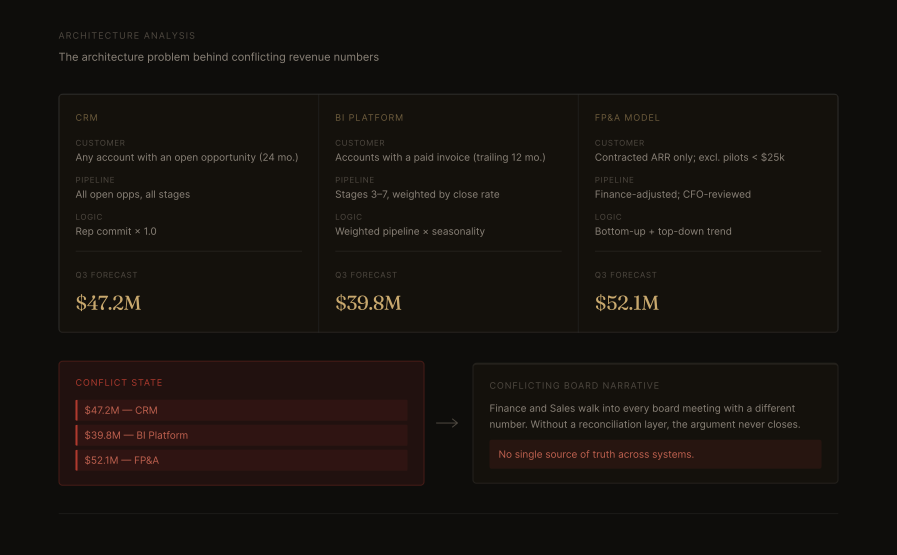
Financial-services revenue teams often operate across CRM, FP&A models, BI dashboards, product systems, transaction systems, relationship-review decks, and line-of-business pipeline tools. Each system exists for a reason. Each captures a different slice of the client relationship. Over time, the CRM has one version of the account, FP&A has another, BI has a third, the line-of-business team has a fourth, and the warehouse tries to reconcile them after the fact.
The visible cost is licensing overlap and reconciliation overhead. The invisible cost — missed forecasts, conflicting board narratives, and stalled AI initiatives that inherited contradictory inputs — is significantly higher, and none of it shows up as a line item until a QBR exposes it.
Three structural facts.
Fact one. Each system was built around a different atomic unit. CRMs around accounts. CDPs around customer profiles. Warehouses around events and transactions. Aligning them without an explicit semantic layer produces three legitimate but different answers.
Fact two. Even when the systems agree on the client, they rarely agree on the opportunity. A pipeline item counted as one deal in the CRM may appear as three items in a regional tool and zero in the FP&A model that has not been refreshed for two weeks.
Fact three. The reconciliation work is invisible labour. RevOps and FP&A burn cycles aligning numbers no one will look at after the meeting. The labour is real but unattributed; it does not appear in any system's cost ledger.
The CRO sees the real issue: the enterprise does not have a trusted revenue data foundation. It has a collection of locally useful systems that never agreed on what "truth" means.
What a Single Source of Truth Actually Means in Financial Services
SSOT in revenue is often confused with one of three weaker things.
Not one big database. Centralising data in a warehouse without governance produces a single point of confusion, not truth. A warehouse with five definitions of "active client" is still ambiguous; the ambiguity is now in one place instead of five.
Not one tool. A CRM, even an enterprise-grade one like Salesforce or Microsoft Dynamics 365, is a system of record. It is not an SSOT for revenue data if the cross-LOB, transaction, product, and external context live elsewhere.
Not one dashboard. A unified BI view on top of inconsistent sources is a sleeker presentation of the same disagreement.
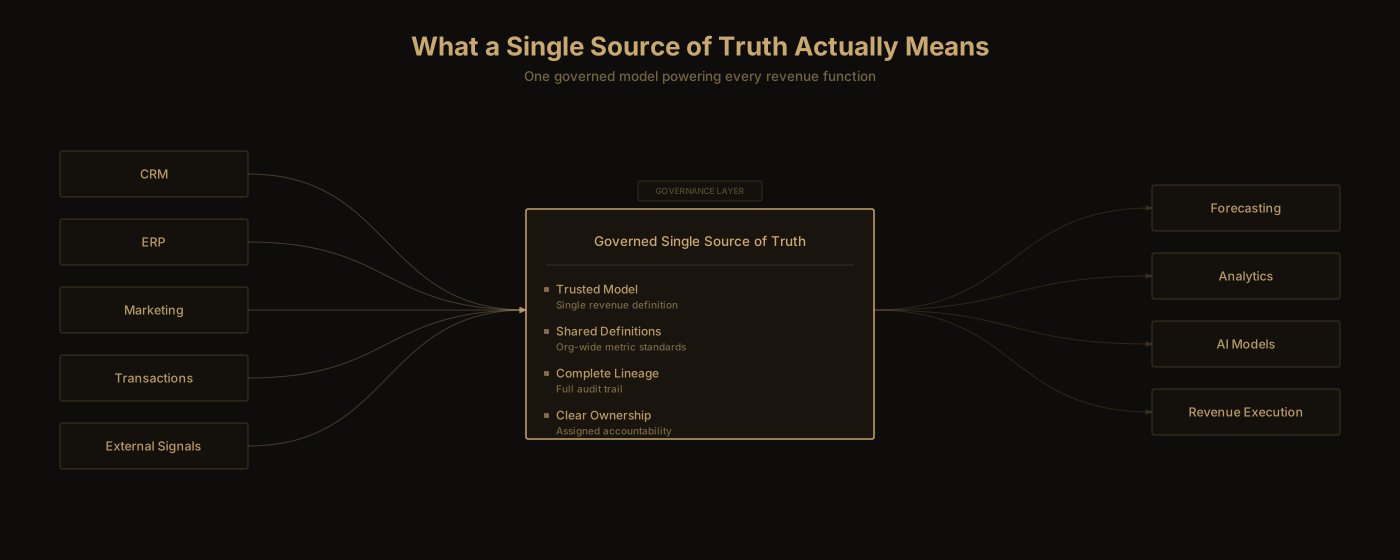
What SSOT actually is: a governed, semantically consistent revenue data layer with shared definitions, documented lineage, accountable ownership, and cross-system consistency. In financial services, that layer also needs hierarchy-aware entity resolution so the institution can understand the same client across households, subsidiaries, funds, sponsors, legal entities, products, and relationship teams. Four elements.
- Shared definitions. Every team uses the same definition of customer, client, household, legal entity, relationship, opportunity, product, pipeline stage, revenue, and product utilization. Definitions are versioned and reviewed.
- Documented lineage. Every metric can be traced back to its source systems with explicit transformation steps. The same query returns the same answer two months later. This matters when a forecast number, account score, or next-best-action recommendation needs to be explained.
- Single ownership. A named owner for each entity and metric, with accountable ownership shared across business, data, and RevOps teams. Disputes resolve to a single person.
- Cross-system consistency. CRM, BI, FP&A, AI systems, banker and advisor workflows, and relationship-review processes all consume the same canonical layer. They are presentation layers, not competing sources.
When all four are in place, the board meeting has one number. When any one is missing, the reconciliation begins.
Why Revenue Data Silos Persist
Three structural reasons enterprises stall before they reach SSOT.
Tool sprawl with conflicting writes. Large enterprises run sprawling SaaS estates, and many of those tools write conflicting versions of the customer or the opportunity. Without explicit data contracts between systems, the conflicts go unnoticed until QBR.
Line-of-business silos. In BFSI, commercial banking, wealth, capital markets, payments, treasury, and lending often maintain separate systems, KPIs, and relationship views. A client that appears as a corporate borrower in one system may also be a treasury customer, an executive wealth relationship, a payments user, and an institutional prospect somewhere else. Without a canonical revenue layer, the cross-sell signal dies before it reaches the right relationship owner.
Shadow data proliferation. When official systems disagree, teams create their own truth. FP&A keeps a forecast spreadsheet. A regional banking team maintains a relationship-review deck. Institutional sales tracks mandate context outside CRM. Wealth teams keep client notes in local planning tools. These shadow systems are not created because teams want chaos. They are created because the official systems do not answer the revenue questions teams actually need to act on.
These three compound. By the time a CRO recognises the enterprise lacks an SSOT, the institution has typically been operating without one for years. Recovery is architectural, not incremental — and it usually begins by fixing fragmented CRM data at the source rather than treating dirty CRM data as a downstream cleanup problem.
Three Architectures for Revenue SSOT
Three architecture patterns compete for the role of revenue SSOT. The right answer depends on scale, complexity, and whether the goal is reporting accuracy or operational action.
Architecture 1 — CRM-as-SSOT. The historical default. The CRM is treated as the canonical layer for customer, pipeline, and revenue. Everything else — BI, FP&A, AI — consumes from the CRM. This can work when the sales motion is simple and most revenue activity already lives in CRM. It breaks in financial services when the revenue picture depends on core banking, transactions, product usage, market activity, householding, legal hierarchies, and external signals that CRM was never designed to govern.
Architecture 2 — CDP-as-SSOT. CDPs are useful for unifying customer profiles and activation audiences, especially in marketing-led environments. But they are usually not designed to become the operating layer for relationship-manager prioritization, multi-entity legal hierarchy resolution, product whitespace, or BFSI buying-signal detection. For SellWizr's ICP, a CDP may be an input to the revenue SSOT, but it should not be treated as the full answer.
Architecture 3 — Warehouse/Lakehouse + Execution Layer. Modern enterprise pattern. The warehouse or lakehouse holds canonical data with a governed semantic layer on top. Above it, an execution layer resolves entities, ingests relevant revenue signals, ranks next-best actions, and prepares work for human review inside existing banker, advisor, or sales workflows. CRM remains the system of record for the relationship team. The warehouse remains the governed data foundation. The execution layer closes the loop between trusted data and revenue action.
| Architecture | Strength | Gap | Best fit |
|---|---|---|---|
| CRM-as-SSOT | Familiar and close to seller workflow | Weak for cross-system data, hierarchy modeling, transaction signals, and product context | Simpler single-system sales teams |
| CDP-as-SSOT | Strong for profile unification and marketing activation | Not designed for BFSI revenue execution, legal hierarchies, or RM prioritization | Marketing-led customer activation |
| Warehouse/Lakehouse + Execution Layer | Canonical data, governed semantics, entity resolution, signal prioritization, and workflow handoff | Requires clear governance and operating ownership | Enterprise financial services teams |
Architecture 3 is the pattern financial-services organizations move toward when reporting consistency is no longer enough. The strategic question is whether to custom-build the execution layer or use a platform designed to sit above existing data and workflow systems.
The Governance Layer That Keeps Truth From Decaying
The architecture chooses the topology. The governance layer determines whether the SSOT actually compounds.
Four governance components.
Data contracts. Data contracts define what each system must provide, what each field means, how it is refreshed, and what happens when the contract breaks. They prevent silent drift between CRM, warehouse, BI, AI models, and workflow tools.
Lineage. Every metric in every report can be traced back to its source records with documented transformations. A query run today produces the same answer two months from now. This matters when a forecast number, account score, or next-best-action recommendation needs to be explained.
Semantic layer. The semantic layer translates raw system data into agreed business concepts: client, household, legal entity, product, opportunity, relationship owner, pipeline stage, revenue, utilization, and signal. Without it, different teams can query the same warehouse and still reach different conclusions.
Master data ownership. Each core entity and metric needs an accountable owner. Without ownership, definitions drift, exceptions multiply, and the SSOT becomes another system people work around.
Without governance, even Architecture 3 collapses into a tidier mess. With governance, even Architecture 1 can be made to work for several years. The combination of Architecture 3 plus governance is what produces SSOT at enterprise scale.
Why Financial Services Needs an Execution Layer Above the Warehouse

A warehouse-plus-governance model can create trusted reporting. In financial services, the harder question is whether trusted data changes the revenue motion. Does it help a banker see which deposit shift matters? Does it help an advisor identify a household-level opportunity? Does it help an institutional sales team connect a corporate action, fund flow, or hierarchy change to the right next step?
Operational requirement one — hierarchy-aware entity resolution. Financial-services relationships are rarely flat. A single client relationship may span parent companies, subsidiaries, funds, SPVs, trusts, households, sponsors, executives, and related entities. The warehouse can store these records, but the revenue team needs an execution layer that resolves them into usable relationship context. This is what a real client 360 view requires.
Operational requirement two — signal-driven prioritization. Revenue teams do not need another place to look for data. They need a ranked view of what changed and why it matters. Deposit movement, transaction behavior, product gaps, relationship changes, market events, and external triggers only become useful when they are prioritized against the right account, owner, and action — which is the point of unifying sales signals against internal and external data.
Operational requirement three — human-in-the-loop actioning. Financial-services teams need AI next-best-action recommendations that remain reviewable. The execution layer should prepare the action, explain the reason, and route it into the relationship manager's workflow without removing human judgment from the process.
This is where SellWizr fits. SellWizr is not trying to replace the warehouse, CRM, or BI layer. It sits above existing data and workflow systems to resolve account and client context, detect relevant revenue signals, recommend next-best actions, and keep the relationship owner in control of execution — the operating layer behind revenue execution for financial services.
The CRO Diagnostic: Can You Rebuild the Number?
The boardroom test: "Can the enterprise rebuild yesterday's pipeline number from first principles two months from now — and arrive at the same answer?"
If the answer requires reconciling CRM exports, BI dashboards, FP&A spreadsheets, and line-of-business decks, the organization does not yet have a true single source of truth for revenue data.
If the answer is yes, the foundation exists. The next question is whether that trusted foundation feeds an execution layer: can the same data identify the right relationship, surface the right signal, recommend the right next step, and route that action to the right human?
That distinction matters. Reporting truth helps leaders trust the number. Operational truth helps teams act on it.
Conclusion
A single source of truth for revenue data in financial services is not one database, one CRM, or one dashboard. It is a governed revenue data foundation with shared definitions, documented lineage, accountable ownership, hierarchy-aware entity resolution, and cross-system consistency.
The architecture matters. CRM-as-SSOT can work only when the revenue motion is simple. CDP-as-SSOT can help with profile unification, but it is usually not enough for BFSI revenue teams. The modern enterprise pattern is a warehouse or lakehouse with a governed semantic layer and an execution layer above it.
For financial services, that final layer is what separates trusted reporting from revenue action. The institution needs to know not only which number is correct, but which client, account, hierarchy, product gap, or transaction signal deserves attention next.
SellWizr helps financial-services teams operationalize that trusted foundation by resolving client and account context, detecting revenue signals, recommending next-best actions, and keeping relationship managers, advisors, and sales teams in control of execution.
The CRO diagnostic remains simple: can you rebuild the number later and act from it today? If not, the enterprise does not yet have the revenue data foundation its AI, forecasting, and growth strategy depend on.
Summary. A single source of truth for revenue data in financial services is a governed, semantically consistent layer that CRM, BI, AI, forecasting, and revenue workflows can trust. It is not one database or one dashboard. The strongest enterprise pattern is a warehouse or lakehouse with a semantic layer and an execution layer above it. Governance creates trust; entity resolution creates usable financial-services context; execution turns trusted data into prioritized next-best actions for relationship teams.
FAQ
What is a single source of truth for revenue data in financial services?
It is a governed, semantically consistent layer that defines the trusted version of account, client, relationship, pipeline, product, and revenue data across systems. It gives CRM, BI, AI, forecasting, and workflow tools a shared foundation.
Is a single source of truth the same as one database?
No. A single database can still contain conflicting definitions. A true SSOT requires shared business definitions, lineage, ownership, and governance so every system interprets revenue data the same way.
Why do financial-services revenue teams struggle with SSOT?
BFSI organizations often have separate systems across banking, lending, wealth, capital markets, payments, treasury, product, and CRM. Each system can be correct locally while still creating conflicting enterprise-level revenue views.
Why is entity resolution important for revenue data?
Financial-services relationships span households, legal entities, subsidiaries, funds, trusts, sponsors, and related parties. Entity resolution connects those records into usable relationship context so revenue teams can see the full opportunity.
Does SSOT replace CRM?
No. CRM remains the system of record for relationship activity. The SSOT provides the governed data foundation that CRM, BI, AI, forecasting, and workflow tools can consume.
Why does financial services need an execution layer above the warehouse?
The warehouse can establish trusted data, but revenue teams need prioritized action. An execution layer detects signals, resolves account context, recommends next-best actions, and routes work to relationship owners for review.
How is SSOT different from a client 360 platform?
Client 360 is usually a view of the client. SSOT is the governed data foundation behind that view. In financial services, the strongest approach connects both: trusted data, hierarchy-aware context, and action-oriented recommendations.
What is the first step toward a revenue SSOT?
Start by identifying where revenue definitions conflict: customer, account, opportunity, product, pipeline, revenue, and relationship owner. Then assign ownership, define lineage, and determine which systems should consume the canonical layer.
Build a revenue data foundation your teams can actually act on.
SellWizr helps financial-services organizations connect account, client, product, CRM, transaction, and external context into a governed execution layer for revenue teams. See how trusted data becomes prioritized action inside existing workflows.