Revenue Infrastructure Engineering: How Financial Services GTM Becomes Production Software
Revenue infrastructure engineering applies software engineering discipline to financial-services GTM systems, turning CRM, client data, signal detection, and AI next-best-action workflows into governed production infrastructure.
Revenue infrastructure engineering is the discipline of applying software engineering rigor — data contracts, versioning, observability, idempotency, automated testing, lineage, and modular orchestration — to enterprise go-to-market systems. For financial services teams, that means treating CRM data, account hierarchies, transaction signals, enrichment, decisioning, and AI next-best-action delivery as production infrastructure rather than disconnected configuration. The result is a governed data-to-decision loop that revenue, RevOps, data, and technology teams can inspect, improve, and operate with confidence.
Table of Contents
- What Is Revenue Infrastructure Engineering?
- Why Financial Services GTM Needs Engineering Discipline
- RevOps Runs the Revenue System; GTM Engineering Builds It
- The Five-Layer Revenue Infrastructure Reference Architecture
- Why BFSI Raises the Bar for GTM Infrastructure
- The Operating Model: Embedded with RevOps, Governed Like Software
- What to Look for in a Revenue Infrastructure Platform for Financial Services
- How Engineered GTM Compounds
- Conclusion: From Configured GTM to Engineered Revenue Systems
- FAQ
Introduction
This article is written for the technical buyer inside the financial-services revenue stack: the Head of RevOps, GTM Engineer, Director of Sales Systems, revenue architect, data leader, or technology partner responsible for making revenue workflows reliable at scale.
The people and hiring model behind this function are covered in the rise of GTM engineering teams in enterprise organizations. This post focuses on the architecture: the infrastructure required to make CRM, client data, hierarchy resolution, signal detection, AI next-best-action, and workflow delivery operate like a production system.
Revenue infrastructure engineering exists because financial-services GTM systems can no longer be managed as a collection of configured tools. Banks, lenders, asset managers, wealth firms, transaction banking teams, and capital markets groups work across complex account hierarchies, regulated data environments, multiple systems of record, and relationship-driven sales motions. When AI next-best-action enters that environment, the system needs more than another dashboard. It needs contracts, lineage, observability, rollback paths, and clear ownership.
This article defines revenue infrastructure engineering, separates it from RevOps, lays out a five-layer reference architecture, and explains why BFSI raises the engineering bar beyond most horizontal enterprise sales environments. For the broader category context, see revenue execution for financial services.
The image presents a high-level view of revenue infrastructure engineering for financial services: fragmented data sources are unified into an engineered architecture with data contracts, lineage, observability, and AI next-best-action delivery that produces auditable revenue actions inside relationship-manager workflows.
What Is Revenue Infrastructure Engineering?
Revenue infrastructure engineering is the application of software engineering principles to enterprise GTM systems. In financial services, that means CRM, enrichment, product data, transaction data, client hierarchies, signal detection, AI decisioning, and next-best-action delivery are treated as production systems rather than configurable business applications.
The discipline emerged because the old model broke. The old model was "configure the CRM, plug in 12 tools through native connectors, and let RevOps reconcile the rest." That worked while the tools were simple and the volumes were small. It does not work when the system has 30+ integrations, ten of them produce signals, six write back to the CRM, three score the same opportunity differently, and nobody can tell which one was canonical when a deal is reviewed in QBR.
A revenue infrastructure engineer treats that mess like backend engineers treat a microservices estate. Define the contracts between services. Make every write idempotent. Log lineage. Instrument SLOs. Separate decisioning from delivery. Make every recommendation reproducible from inputs. Build the loop the same way you would build any other production system: with telemetry, rollback, and observability from day one.
The shift in mindset is the shift from "GTM as configuration" to "GTM as software." Configuration tolerates ambiguity. Software does not. For financial-services institutions, the stakes are higher because the same workflow may depend on KYC-linked entities, parent-subsidiary relationships, household structures, product eligibility, data residency rules, and relationship-manager approval paths.
Why Financial Services GTM Needs Engineering Discipline
The rise of GTM engineering is a response to three pressures: AI-native tooling, sales-tech sprawl, and the need to make revenue workflows measurable and reproducible. In financial services, those pressures are amplified by regulated data environments, multi-entity client structures, and high-value relationship motions where a bad recommendation is not just inefficient — it can erode trust.
AI-native tooling matured. When MCP-based agents (MCP is Anthropic's Model Context Protocol, the open standard for how AI agents communicate with tools and data sources), LLM-orchestrated pipelines, and SDK-first GTM platforms became production-grade, the configuration model stopped being sufficient. Agents are software. Orchestrating them requires engineering ownership, not RevOps configuration.
Sales-tech sprawl became untenable. Enterprise sales teams now run 12–30 tools. Each has its own data model, its own scoring logic, and its own integration assumptions. The marginal RevOps configurator cannot keep the system coherent. Someone with engineering depth has to take ownership of the loop.
Reproducibility and traceability became business requirements. As AI moves closer to client-facing actions in banking, wealth, asset management, and lending, revenue leaders need to explain why a recommendation was made, which inputs drove it, and whether the action produced a measurable outcome. Configured GTM cannot answer those questions consistently.
The hiring signal reflects this shift: job postings and team titles have increased as enterprise organizations formalize the GTM engineering function. Recruiting-firm compensation data from Betts Recruiting suggests GTM engineers at AI-native companies command roughly $180K–$240K base with top firms reaching $250K–$300K total — indicative figures that should be validated against current market data before being used as benchmarks.
RevOps Runs the Revenue System; GTM Engineering Builds It
The cleanest framing the industry has converged on: GTM engineering is the build side; RevOps is the run side (Factors).

The infographic contrasts GTM Engineering and RevOps. GTM Engineering owns building production systems such as data pipelines and agent workflows, while RevOps owns operating cadence, forecast governance, and business execution.
A GTM engineer designs enrichment pipelines, ships scoring models, builds agent workflows, writes data contracts, and owns the deployment lifecycle. A RevOps leader operates those systems: runs forecasting cadences, manages hygiene, governs adoption, owns territory and quota mechanics, and reports to the CRO on attainment.
| Dimension | GTM Engineering (build) | RevOps (run) |
|---|---|---|
| Primary output | Production systems, pipelines, agents | Operational rhythm, forecast accuracy, hygiene |
| Cadence | Sprint-based with versioned releases | Weekly/monthly business cadence |
| Tooling | Warehouse, dbt, orchestrator, SDK, IDE | CRM, BI, forecasting suite |
| Failure mode | Bug ships to production | Forecast misses |
| Reports to | CTO or CRO depending on firm | CRO |
| Skills | Software engineering, data engineering, ML | Process design, analytics, change management |
In a financial-services environment, the handoff matters. GTM engineering should own the reliability of the pipelines, data contracts, decisioning logic, and write-back paths. RevOps should own adoption, operating cadence, field enablement, forecasting, and business interpretation. When those roles blur, AI programs often become fragile: the model may work, but the workflow around it cannot be trusted.
Mature enterprises staff both. The mistake mid-market firms make is asking RevOps to absorb the engineering work; the result is brittle systems and burnt-out talent. The mistake fintech firms sometimes make is asking GTM engineers to also own forecast accuracy; the result is systems shipped without the operational discipline that makes them defensible.
The correct architecture is two functions, one revenue mission, with explicit handoffs between them.
The Five-Layer Revenue Infrastructure Reference Architecture
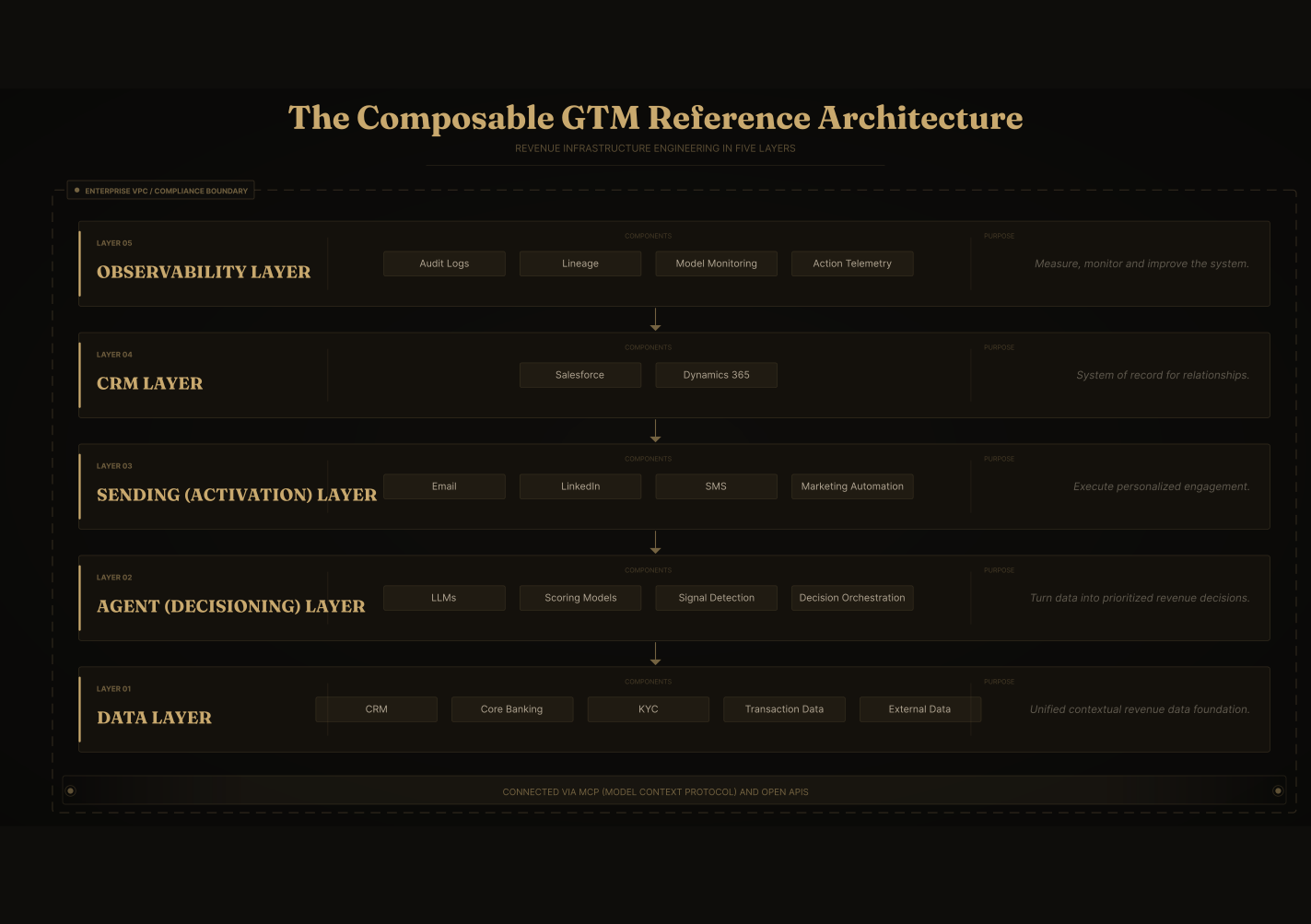
A practical revenue infrastructure architecture has five layers: data, decisioning, delivery, CRM, and observability. The goal is not to replace every system in the GTM stack. The goal is to make the movement from data to recommendation to action governed, inspectable, and adaptable.
The diagram shows five stacked layers in a revenue infrastructure architecture for financial services: data foundation, AI decisioning, workflow delivery, CRM as system of record, and observability with lineage and outcome telemetry.
Layer 1 — Data. Warehouse or lakehouse (Snowflake, Databricks, Redshift) fed by financial-services data sources: CRM; core banking, policy or admin systems where relevant; transaction warehouses; product systems; external market and company data; and relationship and hierarchy data. dbt or equivalent for transformation. Reverse ETL (Hightouch, Census) for activation. Combining internal and external data is the substrate everything else depends on.
Layer 2 — Agent / Decisioning. Where the model lives. LLM-agnostic. Reads from the data layer. The decisioning layer should produce ranked recommendations, relationship insights, escalation prompts, and AI next-best-actions that can be traced back to source data and business rules. The agent layer is the part most vendors get wrong by locking it to a single model or proprietary scoring system.
Layer 3 — Delivery. Sequencing, channel routing, message delivery (sales engagement platforms, marketing automation, email APIs). Receives decisions from the decisioning layer; executes delivery. Engagement is delivery, not decision. See how this connects to unifying sales signals across channels.
Layer 4 — CRM (system of record). Salesforce, Microsoft Dynamics 365, or industry equivalent. The CRM remains the operating surface for relationship managers, bankers, advisors, and sales teams. Revenue infrastructure should enrich and activate CRM workflows without turning the CRM into the only place where intelligence is created. Every decision the decisioning layer produces must write back here with lineage attached.
Layer 5 — Observability. Lineage, audit trail, SLOs, model-quality monitoring, action-outcome telemetry. For BFSI teams, observability is not just technical debugging. It is how revenue, data, and governance stakeholders understand why a recommendation was made, which signals contributed to it, and whether the action produced a measurable outcome.
The architectural insight is that each layer is best-of-breed and independently replaceable. The integration is through data and APIs, not vendor-native plumbing. A composable stack outperforms a monolithic suite because the cost of replacing one component is bounded; the cost of replacing a monolith is the org's quarterly revenue.
Why BFSI Raises the Bar for GTM Infrastructure
Financial services introduces infrastructure requirements that many horizontal GTM tools were not designed to handle.
1. Deployment flexibility. Some institutions require hosted, private, institution-managed, VPC, or air-gapped deployment patterns depending on data sensitivity and internal technology policy. Revenue infrastructure should be able to fit the institution's environment rather than forcing every workflow into a single SaaS model.
2. Entity and hierarchy resolution. Banks, asset managers, wealth firms, and lenders rarely sell to a simple "account." They sell into holding companies, subsidiaries, funds, trusts, households, counterparties, sponsors, and advisor networks. The infrastructure layer needs to resolve those multi-entity client relationships before AI can recommend the right action.
3. KYC-linked and eligibility-aware workflows. In many financial-services motions, a recommendation must account for client status, product eligibility, jurisdiction, and internal relationship ownership. A next-best-action system that ignores those constraints creates operational risk.
4. Auditability and lineage. Every signal, score, recommendation, and CRM write-back should be traceable. Teams need to know which inputs produced an action, when the logic changed, and whether the recommendation was approved, ignored, or acted on.
5. Data residency and governance needs. Large institutions often operate across regions, business lines, and data domains. Revenue infrastructure needs governance patterns that can respect those boundaries while still giving revenue teams usable intelligence.
This is why revenue infrastructure engineering for financial services cannot be reduced to CRM customization or sales-tool integration. The architecture has to make fragmented client, account, product, transaction, and external data usable without sacrificing control, context, or workflow reliability. For a deeper look at the underlying data problem, see why BFSI sales teams are drowning in fragmented CRM data.
The Operating Model: Embedded with RevOps, Governed Like Software
From an architecture standpoint, two operating-model decisions shape the system more than any other.
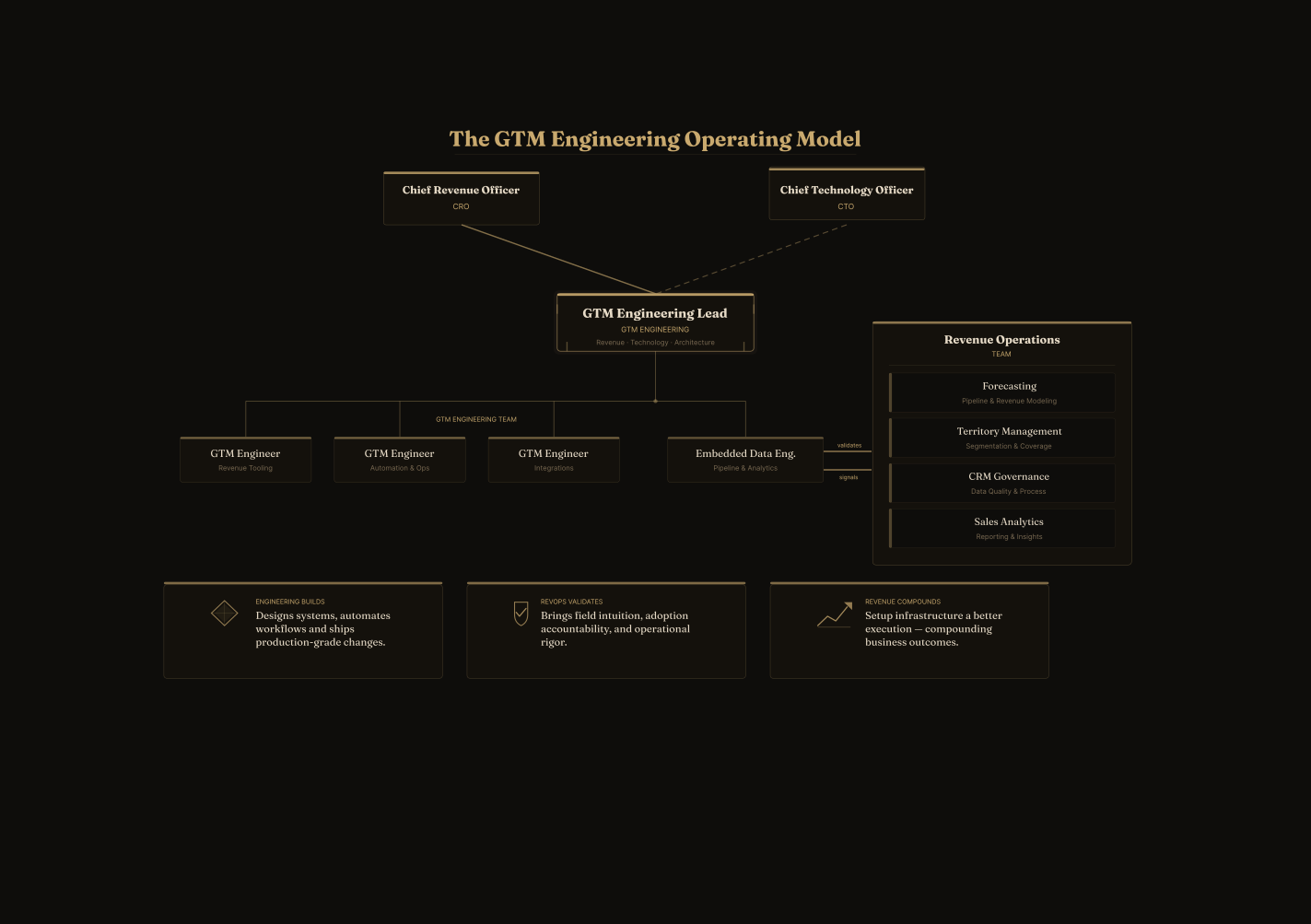
Reporting and embedding. The team is embedded with RevOps, not separated from it — it builds, RevOps validates against operating reality. Two reporting structures work: reporting to the CRO with a dotted line to the CTO (revenue-led enterprises), or to the CTO with a dotted line to the CRO (product-led or data-led enterprises). What does not work is reporting only to marketing or only to IT.
Tooling discipline. The team runs a modern engineering stack: Git, CI/CD, observability tooling (Datadog, Honeycomb), data tooling (Snowflake, dbt, orchestrator), agent platforms, and the CRM SDK. Every change ships through PR review, every system has SLOs, every recommendation has lineage. This is how the engineering bar holds even under pressure to ship.
This operating model should not turn GTM engineering into a shadow IT team or a one-person automation desk. The function should be embedded close enough to RevOps to understand field reality, but governed with enough engineering discipline to protect the integrity of the system.
Team sizing, the hiring rubric, the 90-day OKR template, and the full operating model are covered in depth in the rise of GTM engineering teams in enterprise organizations. This post stays on the architecture; that post owns the people and operating model.
What to Look for in a Revenue Infrastructure Platform for Financial Services
A financial-services revenue infrastructure platform should make the engineered loop easier to build, govern, and operate. It should not become another point tool that adds more scoring logic, more disconnected records, or another place for relationship managers to work.
- Open APIs and SDKs. GTM engineering teams need programmatic access to pipelines, enrichment logic, recommendations, workflow triggers, and write-back behavior.
- LLM-agnostic decisioning. The decisioning layer should support model choice and model changes without forcing a full platform rebuild.
- AI next-best-action with human approval. Recommendations should support banker, advisor, RM, or sales-team review before sensitive actions are taken.
- Native entity resolution. Parent-child company structures, subsidiaries, funds, trusts, households, and related entities should be first-class objects.
- Deployment flexibility. The platform should support the deployment pattern required by the institution.
- Audit logging and explainability. Signals, scores, recommendations, and CRM updates should be traceable.
- Observability and outcome telemetry. Teams need to monitor action delivery, adoption, conversion, drift, and workflow health.
- Separation of decisioning from delivery. The platform should improve decisioning and orchestration without forcing the institution to abandon CRM, engagement, or BI systems that already work.
SellWizr is designed for this infrastructure problem in financial services: resolving entities, unifying account and client context, detecting revenue signals, and delivering AI next-best-actions into existing workflows with humans in the loop.
How Engineered GTM Compounds
External research suggests that better-aligned revenue systems can improve growth and profitability, but the more practical lesson is architectural: reliable GTM systems compound when each deployment becomes reusable infrastructure.
The return from revenue infrastructure engineering compounds because every reliable system becomes the foundation for the next one. The first deployment may resolve client hierarchies and clean the data-to-CRM loop. The next adds signal detection. The next improves AI next-best-action recommendations. The next expands across a new business line. Over time, the institution is not just adding tools. It is building an operating layer that makes future revenue workflows faster to launch and easier to govern.
The data architecture that makes this compounding possible is covered in single source of truth for revenue data in financial services, and the AI deployment patterns that ride on top of it are covered in AI sales intelligence for banks.
Conclusion: From Configured GTM to Engineered Revenue Systems
Revenue infrastructure engineering is the discipline that turns financial-services GTM from configured tooling into governed production software.
For banks, lenders, asset managers, wealth firms, and other financial-services organizations, the problem is not simply that revenue data is fragmented. The deeper issue is that CRM records, transaction data, client hierarchies, product systems, external signals, AI models, and workflow tools often operate without a shared engineering layer.
That is what revenue infrastructure engineering changes. It gives GTM teams the contracts, lineage, observability, deployment discipline, and decisioning architecture required to move from data to recommendation to action with confidence.
The institutions that treat GTM as infrastructure will be better positioned to scale AI next-best-action, relationship intelligence, and revenue execution across business lines. The institutions that keep treating GTM as configuration will continue to accumulate workflow debt with every new tool they add.
Explore how the SellWizr platform helps financial-services teams build the infrastructure layer for entity resolution, client context, signal detection, and AI next-best-action delivery.
Summary. Revenue infrastructure engineering applies software engineering discipline to financial-services GTM systems. Instead of treating CRM, enrichment, signal detection, AI decisioning, and workflow delivery as disconnected configurations, it treats them as production infrastructure with data contracts, lineage, observability, idempotency, versioning, and clear ownership. For BFSI teams, the discipline matters because revenue workflows often depend on entity resolution, hierarchy modeling, governed data environments, product eligibility, and human-in-the-loop action approval. The strongest architecture separates data, decisioning, delivery, CRM, and observability while keeping those layers connected through APIs, SDKs, and auditable write-back paths.
FAQ
What is revenue infrastructure engineering?
Revenue infrastructure engineering is the discipline of applying software engineering practices to go-to-market systems. It treats CRM data, enrichment, signal detection, AI decisioning, workflow automation, and CRM write-back as production infrastructure with contracts, versioning, observability, and auditability.
Why does financial services need revenue infrastructure engineering?
Financial-services GTM systems often depend on fragmented client data, complex account hierarchies, regulated data environments, KYC-linked entities, product eligibility rules, and relationship-manager workflows. Revenue infrastructure engineering gives those systems the reliability and traceability needed to support AI next-best-action and revenue execution at scale.
How is revenue infrastructure engineering different from RevOps?
RevOps typically owns revenue process, forecasting cadence, adoption, reporting, and operational governance. Revenue infrastructure engineering owns the build side: data pipelines, entity resolution, decisioning logic, workflow orchestration, observability, and deployment discipline. Mature teams need both.
What systems are part of revenue infrastructure?
Revenue infrastructure can include CRM, data warehouse or lakehouse, enrichment sources, transaction and product systems, entity resolution, signal detection, AI decisioning, sales engagement tools, workflow orchestration, and observability layers.
What is a data contract in a GTM system?
A data contract defines how information moves between systems, what fields are required, how data is formatted, and what downstream workflows depend on it. In GTM systems, data contracts help prevent broken enrichment, duplicate records, unreliable scoring, and inconsistent CRM write-backs.
Why does entity resolution matter for financial-services GTM?
Financial-services relationships often span parent companies, subsidiaries, funds, trusts, households, sponsors, and related entities. Entity resolution helps revenue teams understand those relationships so recommendations, account coverage, and next-best-actions are based on the real client structure rather than isolated CRM records.
How does revenue infrastructure support AI next-best-action?
AI next-best-action depends on reliable inputs, clear decisioning logic, workflow context, and feedback loops. Revenue infrastructure provides the data foundation, entity context, lineage, and observability needed to recommend actions that teams can understand, approve, and measure.
Is revenue infrastructure engineering only for banks?
No. Banks are a strong fit because of their data complexity and relationship-driven sales motions, but the discipline also applies to lenders, wealth managers, asset managers, fintechs, payments teams, transaction banking teams, and capital markets organizations.
What should financial-services teams look for in a revenue infrastructure platform?
Look for open APIs, SDK access, native entity resolution, deployment flexibility, LLM-agnostic decisioning, audit logging, observability, human-in-the-loop controls, and the ability to deliver recommendations into existing CRM and revenue workflows.
How does SellWizr support revenue infrastructure engineering?
SellWizr helps financial-services teams resolve entities, unify account and client context, detect revenue signals, and deliver AI next-best-actions into existing workflows. It is designed to support the infrastructure layer between fragmented BFSI data and governed revenue action.
Want to see SellWizr in action?
See how the platform turns fragmented revenue data into ranked actions your team can actually use.