The Rise of GTM Engineering Teams in Enterprise Financial Services
GTM engineering is becoming the build-side discipline behind enterprise revenue systems. Here's how it differs from RevOps, what the operating model looks like, and why financial institutions need this capability as AI moves from pilot to production.
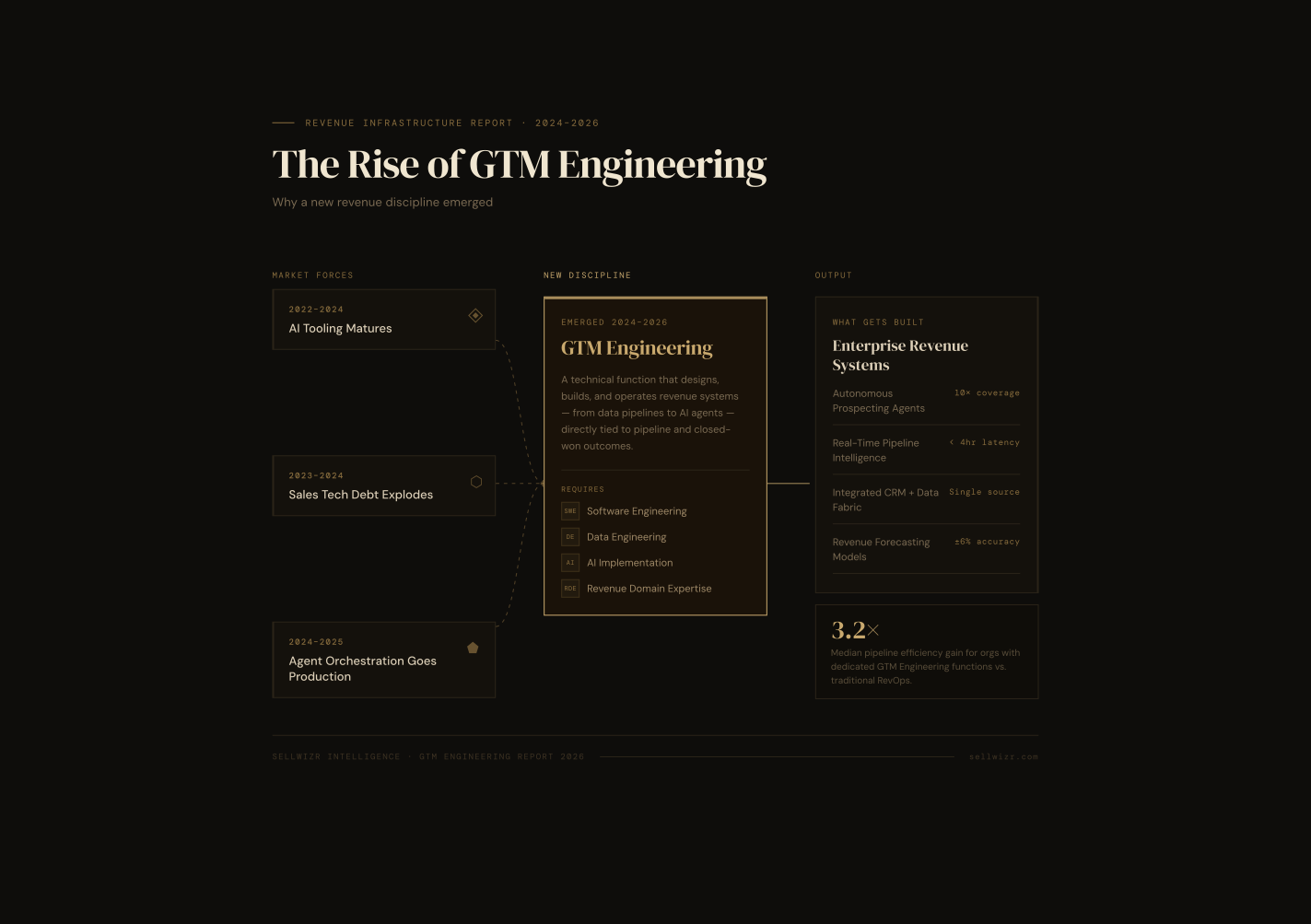
GTM engineering is the build-side discipline behind modern enterprise revenue systems. It brings software engineering, data engineering, and AI implementation skills into the GTM function so teams can design the pipelines, scoring models, agent workflows, CRM integrations, and observability layers that RevOps operates. For financial institutions, the need is sharper: multi-entity hierarchies, regulated deployment requirements, auditability, KYC linkage, and model governance make GTM systems an engineering problem, not just an operations workflow.
Table of Contents
- Why GTM Engineering Hiring Just Grew 205% in a Year
- What a GTM Engineer Actually Does
- GTM Engineering vs RevOps — Build vs Run
- Why the Role Emerged Now
- The Operating Model
- Why Enterprise Financial Institutions Need GTM Engineers Most
- Why Hiring More Software Engineers Isn't the Same Solution
- How to Hire a GTM Engineer
- FAQ
Introduction
GTM engineering is the build-side discipline inside enterprise revenue teams. It applies software engineering, data engineering, and AI implementation expertise to the systems that revenue teams increasingly depend on: enrichment pipelines, scoring models, AI-assisted workflows, CRM writebacks, signal triage, and next-best-action delivery.
The simplest distinction is this: GTM engineering builds the revenue systems; RevOps runs the operating rhythm around them. RevOps owns forecast discipline, process, reporting, governance, and adoption. GTM engineering owns the technical substrate that makes those workflows reliable enough to use in production.
The role has become more visible as enterprises move AI revenue initiatives out of pilots and into live workflows. Job-posting analyses suggest rapid growth in GTM engineering demand, and compensation has followed. Before publishing specific figures such as "205% YoY" or compensation bands, SellWizr should confirm the source and add a citation. The point remains clear: enterprise revenue teams are realizing that AI-native GTM systems require builders, not just administrators.
Financial institutions have the strongest case for this function. Banks, lenders, wealth managers, asset managers, and fintechs operate across fragmented systems, regulated data environments, complex client hierarchies, and approval-heavy workflows. A generic no-code orchestration layer may help with simple automation, but production-grade revenue execution for financial services usually requires engineering discipline: data contracts, observability, audit trails, entity resolution, and deployment review.
This article defines the role, explains how GTM engineering differs from RevOps, outlines the operating model, and gives CROs, CDOs, CTOs, and revenue leaders a practical hiring framework for 2026 planning.
Why GTM Engineering Hiring Just Grew 205% in a Year
The number is useful, but the operating-model shift behind it matters more.
If the 205% hiring-growth figure is externally verified, keep it as the headline statistic and cite the source directly. If not, soften the claim to: GTM engineering job postings appear to be growing quickly as enterprise teams formalize ownership for AI revenue systems. Reported analyses suggest compensation has followed, but specific base and total-comp bands should be cross-referenced against a public benchmark before treating them as hard facts.
The structural reason is straightforward: enterprises have reached the point where GTM systems need engineering ownership. AI enrichment, scoring, agent workflows, CRM writebacks, and observability cannot be managed indefinitely as side projects inside RevOps.
One — AI moved from experimentation to implementation. Revenue teams are no longer asking whether AI can draft an email or summarize an account. They are asking how to govern, test, monitor, and deploy AI-assisted workflows inside existing systems.
Two — GTM data became too fragmented for manual operations. CRM, product systems, transaction data, market signals, support history, and external data all carry pieces of the account picture. RevOps can define the operating rules, but someone has to engineer the pipelines, matching logic, and feedback loops. The pattern is described in more depth in why sales tech stacks keep failing and in the case for a single source of truth for revenue teams.
Three — enterprise revenue architecture became composable. The modern GTM stack is no longer one suite. It is a set of connected layers: data, decisioning, workflow, CRM, and observability. That architecture needs a function that understands both engineering boundaries and revenue outcomes.
What a GTM Engineer Actually Does
A working GTM engineer's week is a mix of five concrete responsibilities.
1. Enrichment and entity-resolution pipelines. GTM engineers ingest CRM records, internal product data, transaction history, external firmographic data, market events, and intent signals. In financial services, this often means resolving accounts across parent companies, subsidiaries, funds, trusts, households, advisors, and legal entities. The entity resolution problem for multi-entity client relationships is one of the most common first workloads for a new team.
2. Scoring and decisioning models. They build and maintain models for account prioritization, cross-sell propensity, churn risk, wallet expansion, and relationship coverage. The best GTM engineers know when to use LLMs and when simpler scoring logic or classical ML is more reliable.
3. AI-assisted workflows. They design workflows for account research, meeting preparation, outreach drafting, signal triage, and follow-up routing. The goal is not automation for its own sake; it is to reduce manual work while keeping relationship managers, advisors, or sales teams in control. Signal triage and prioritization patterns are covered in unifying sales signals into ranked action.
4. CRM and workflow integration. GTM engineers connect recommendations and next-best actions into the tools teams already use. In BFSI, that means respecting permissions, eligibility rules, approval paths, audit requirements, and CRM system-of-record constraints.
5. Telemetry and reliability. They track adoption, action completion, model drift, signal accuracy, pipeline freshness, and system errors. Without telemetry, AI revenue work becomes anecdotal. With telemetry, teams can see what is being used, what is being ignored, and what needs to improve.
GTM Engineering vs RevOps — Build vs Run
The cleanest framing the industry has converged on is build vs run.
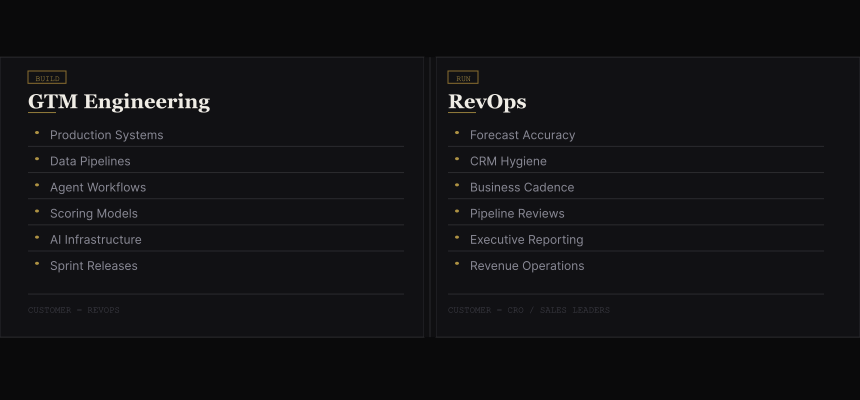
| Dimension | GTM Engineering (build) | RevOps (run) |
|---|---|---|
| Primary output | Production systems and pipelines | Operating rhythm, forecast accuracy, hygiene |
| Cadence | Sprint-based with versioned releases | Weekly/monthly business cadence |
| Tooling | Git, warehouse, dbt, enrichment platforms, agent frameworks | CRM, BI, forecasting suite |
| Failure mode | Bug ships to production | Forecast misses |
| Reports to | CTO or CRO | CRO |
| Skill | Software engineering + data + ML + GTM domain | Process design + analytics + change management |
| Customer | RevOps, sales leaders | Sales leaders, CRO, CFO |
The goal is not to make RevOps more technical or to turn software engineers into sales operators. The goal is to separate two different kinds of ownership. RevOps owns the operating system of the revenue organization: process, cadence, reporting, forecasting, and adoption. GTM engineering owns the technical systems those processes increasingly depend on: pipelines, models, integrations, agent workflows, and observability.
That distinction matters in financial services because the cost of unclear ownership is higher. A broken workflow does not just create a messy dashboard. It can surface the wrong client context, miss eligibility constraints, or push relationship teams toward actions that cannot be explained.
This post owns the people and operating model; the deeper architectural framing — the composable layers the team builds against — lives in revenue infrastructure engineering.
Why the Role Emerged Now
GTM engineering emerged because the revenue stack became too technical for RevOps to build alone and too revenue-specific for central engineering to own casually.
RevOps understands the business motion but usually does not own production engineering patterns such as version control, data contracts, idempotency, model monitoring, or API reliability. Central engineering understands those patterns but usually does not live inside sales cadences, forecast calls, CRM governance, or banker/advisor workflows.
GTM engineering fills that gap. It gives enterprise revenue teams a function that can build with engineering rigor while staying close to the revenue operating model. The architectural layers this function ships against — data, decisioning, workflow, CRM, and observability — are described in revenue infrastructure engineering.
The Operating Model
A working GTM engineering function has four characteristics.

This operating model tends to produce results inside a quarter. Variations of it — a team of one inside RevOps, fully outsourced to a consultancy, scattered across functions — tend to stall. The pattern that ships is a small, embedded team with clear ownership across revenue, data, and technology.
Why Enterprise Financial Institutions Need GTM Engineers Most
The case for GTM engineering is especially strong in financial services because the revenue system has to reflect the complexity of the institution itself. Banks, asset managers, wealth managers, lenders, and fintechs do not operate with simple account records or linear sales motions. They work across legal entities, households, funds, regions, products, compliance constraints, and relationship coverage models. The relationship layer that sits on top of that structure is explored in relationship intelligence for BFSI sales teams.
Multi-entity hierarchies require engineering depth. A commercial banking relationship may include a parent company, operating subsidiaries, treasury relationships, lending exposure, card products, and regional coverage. A wealth relationship may include a household, trusts, beneficiaries, advisors, and affiliated businesses. Modeling these relationships cleanly requires more than CRM fields. It requires entity resolution, hierarchy logic, confidence scoring, and maintenance workflows.
Regulated deployment requires platform discipline. Financial institutions often need controlled deployment environments, audit logging, access control, data residency review, and model documentation. A GTM engineering function can translate revenue workflow requirements into technical patterns that security, data, and risk teams can review. A generic no-code orchestration layer often cannot satisfy at the deployment and governance depth financial institutions require.
KYC and eligibility constraints affect recommendations. In BFSI, a next-best action cannot be based only on propensity or revenue potential. It may need to account for KYC status, jurisdiction, product eligibility, relationship ownership, or internal policy. Those constraints must be built into the decisioning layer, not handled as after-the-fact manual review.
Procurement rewards technical fluency. Financial-services buying committees ask hard questions about APIs, observability, audit trails, deployment options, data handling, and integration boundaries. A GTM engineering team helps the revenue organization evaluate platforms — including where internal and external data need to be unified and where automated data cleaning and enrichment fits — with the right technical lens.
Why Hiring More Software Engineers Isn't the Same Solution
The instinctive answer is, "We already have engineers." That is true, but GTM engineering is not just engineering capacity. It is engineering capacity inside a revenue domain.
A central engineering team may know how to build scalable systems, but it may not understand territory models, CRM ownership rules, banker workflows, sales-cycle timing, product eligibility, or RevOps governance. A RevOps team may understand those workflows deeply, but it may not have the technical capacity to design production-grade data pipelines, AI workflows, and observability layers.
GTM engineering exists because both sides are necessary. The role combines technical build skills with GTM domain fluency.
How to Hire a GTM Engineer
A practical hiring rubric.
Core skills (must-have)
- Python or TypeScript fluency
- SQL + dbt
- CRM data models (Salesforce or Microsoft Dynamics)
- API integration and workflow orchestration (modern enrichment platforms, reverse ETL, agent orchestrators)
- LLM and agent framework familiarity (MCP, function calling, retrieval)
- Operational instinct for sales and marketing motions
Differentiating signals (nice-to-have)
- Prior RevOps or sales operations experience
- Open-source contributions to GTM tooling
- Documented case studies of pipelines or models in production
Interview rubric
- Domain fluency — talk through a complex BFSI cross-sell motion. Look for grounded understanding, not jargon.
- Coding — live SQL + Python on a representative GTM problem (entity matching, scoring pipeline).
- System design — walk through architecting a unified pipeline ingest for a multi-LOB bank.
- Communication — draft a RevOps-facing explanation of a complex pipeline.
- BFSI systems fluency — ask the candidate to walk through a real-world revenue workflow involving multiple systems, such as identifying cross-sell opportunities for a commercial banking portfolio or prioritizing advisor outreach across a wealth-management book. Look for whether they understand entity resolution, CRM writebacks, permissioning, eligibility constraints, and the difference between a useful recommendation and an ungoverned automation.
- Cultural fit — does the candidate treat RevOps as the internal customer, or as a constraint?
Compensation (US, 2026)
Reported analyses suggest a wide range across mid-level, senior, and lead GTM engineering roles, with AI-native firms at the top of the band and BFSI total comp typically closer to the middle. Before publishing specific bands, confirm the underlying source and cross-reference with a public benchmark such as levels.fyi.
First-90-day OKRs
-
O1: Ship one governed next-best-action workflow into the CRM for a single line of business.
- KR1: Workflow live within 8–10 weeks.
- KR2: Relationship managers or advisors can see the recommendation, reason, source signal, and suggested action.
- KR3: RevOps validates adoption and feedback weekly.
-
O2: Establish the first production data contract for the workflow.
- KR1: Source systems documented.
- KR2: Refresh cadence and failure handling defined.
- KR3: Data quality checks visible to RevOps and data owners.
-
O3: Create the operating handoff between GTM engineering and RevOps.
- KR1: Ownership map documented.
- KR2: Release process defined.
- KR3: Feedback loop from users to engineering backlog established.
Applied with discipline, this rubric produces hires who ship inside the first quarter. Looser hiring tends to produce a senior RevOps analyst with a Python certification — a hire who stalls within six months.
Conclusion
GTM engineering is not a trend title. It is the build-side function enterprise revenue teams need when AI, data, CRM, and workflow automation become production systems instead of side experiments.
RevOps remains essential. It owns the operating rhythm of the revenue organization. But as revenue workflows become more technical, enterprises need a team that can build the underlying systems with engineering discipline and revenue context.
Financial institutions have the clearest need. Their revenue workflows depend on governed data, complex client hierarchies, eligibility rules, auditability, and integration with systems that were never designed to produce a clean revenue action on their own.
The executive question is no longer whether AI can improve GTM performance. It is whether the organization has the engineering function required to put AI revenue workflows into production safely, measurably, and in the tools teams already use.
For financial-services leaders building that capability, GTM engineering is the team that turns architecture into operating reality. The reference architecture it builds against is described in the SellWizr platform overview.
Summary. GTM engineering is the build-side discipline behind enterprise revenue systems. It applies software engineering, data engineering, and AI implementation skills to enrichment pipelines, scoring models, AI-assisted workflows, CRM writebacks, and observability. GTM engineering vs RevOps is build vs run; mature enterprises staff both. The working operating model is a small embedded team (lead + 2–4 engineers + data engineer) with reporting into CRO, CTO, or — in BFSI — the CDO with CRO accountability. Financial institutions have the clearest need because multi-entity hierarchies, regulated deployment, KYC and eligibility constraints, and auditability turn revenue workflows into engineering problems. Hire on engineering depth plus GTM domain fluency; a first 90-day plan should ship one governed next-best-action workflow, one production data contract, and a clean handoff with RevOps.
FAQ
What is GTM engineering for financial services?
GTM engineering for financial services is the build-side discipline that designs and maintains the technical systems behind revenue workflows. It includes data pipelines, entity resolution, scoring models, AI-assisted workflows, CRM integrations, and observability for banks, asset managers, wealth managers, lenders, and fintechs.
How is GTM engineering different from RevOps?
RevOps runs the revenue operating rhythm: forecasting, reporting, process, governance, and adoption. GTM engineering builds the systems RevOps depends on, including pipelines, models, integrations, workflow automation, and telemetry.
Why do financial institutions need GTM engineering?
Financial institutions have complex client hierarchies, regulated data environments, legacy systems, KYC and eligibility constraints, and strict audit requirements. GTM engineering helps turn those constraints into production-ready revenue workflows.
Where should GTM engineering report in a bank or financial institution?
Common models include CRO reporting with a technical dotted line to CTO, CTO reporting with CRO accountability, or CDO alignment when the work depends heavily on governed data, lineage, and entity resolution. The key is clear ownership across revenue, data, and technology.
What should a GTM engineering team build first?
A strong first project is one governed next-best-action workflow for a specific line of business. It should connect data sources, explain the reason for each recommendation, write into the CRM or workflow layer, and include feedback from relationship managers or advisors.
Is GTM engineering the same as revenue infrastructure engineering?
No. Revenue infrastructure engineering describes the architecture: data layers, decisioning, workflow, CRM, and observability. GTM engineering is the team or discipline that builds and operates against that architecture.
What skills should we hire for in a GTM engineer?
Python or TypeScript, SQL and dbt, CRM data models, API integration and workflow orchestration, LLM and agent framework familiarity, plus operational instinct for sales motions. In financial services, prioritize candidates who can reason about entity resolution, permissioning, eligibility constraints, and CRM writebacks.
What is the minimum viable GTM engineering team size?
Lead plus 2–4 engineers plus an embedded data engineer. Below that, the team becomes a dependency bottleneck. Above 8–10, further specialisation across platform, application, and ML makes sense.
How long does it take a GTM engineering team to ship value?
A scoped first deliverable — one governed next-best-action workflow inside the CRM for one line of business — should land in 8–12 weeks. Teams that miss that window are usually staffed or scoped wrong.
How do GTM engineers relate to AI revenue platforms in financial services?
GTM engineers build inside the platform boundary. The most useful platforms for financial-services GTM engineering teams offer governed data unification, explainable next-best action, CRM writebacks, and deployment flexibility that fits the institution's controls.
Building the technical foundation for AI revenue workflows in financial services?
See how SellWizr supports governed data unification, signal detection, and next-best-action delivery inside existing enterprise revenue systems.